

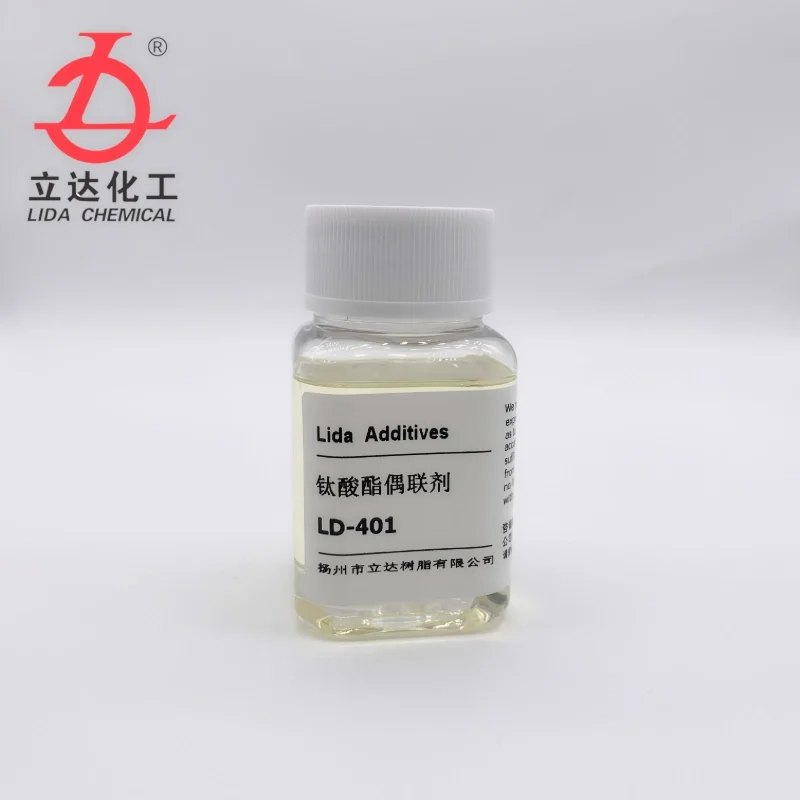
Titanate Coupling Agent LD-401
Titanate Coupling Agent LD-401 is a low-viscosity phosphate polymer for coatings, pigments and fillers, offering adhesion, dispersion, oxidation resistance and flame retardancy.
Product Introduction
The Titanate Coupling Agent LD-401 is a phosphate polymer designed for use as a coupling agent, flame retardant and antioxidant in various coating, resin and composite systems. It has good adhesion to inorganic materials such as metal and glass and can support improved filler dispersion and coating performance.
LD-401 features a low-viscosity transparent liquid appearance, a decomposition temperature of 260°C, a flash point of 130°C, and a density of 0.945 g/cm³. It can be used in both solvent-based and waterborne coating systems, making it suitable for different formulation and processing requirements.
In coating applications, LD-401 can provide catalytic curing effects and help lower baking temperature. It can also improve the dispersion of pigments and fillers, enhance adhesion to inorganic substrates, and support improvements in mechanical, abrasion-resistant and anti-aging properties depending on the formulation.
Yangzhou Lida Resin Co., Ltd. supplies LD-401 for industrial applications involving coatings, resins, pigments, fillers, inks and glass fiber reinforced plastics.
Key Product Features
1. Phosphate Polymer Structure
LD-401 is a phosphate polymer with functional properties that support its use in coating and resin formulations. It can be incorporated into systems requiring coupling, adhesion, dispersion, flame retardancy or oxidation resistance.
2. Oxidation Resistance and Flame Retardancy
The product provides oxidation-resistant and flame-retardant properties, making it suitable for formulations where these characteristics are required.
3. Improved Adhesion to Inorganic Materials
LD-401 has good adhesion to inorganic substrates including metal and glass. It can also improve the adhesion of selected resin systems to different metal surfaces.
4. Pigment and Filler Dispersion
When used to treat inorganic fillers or incorporated during the grinding stage, LD-401 can improve the dispersion of many pigments and fillers. It can also help improve filler anti-settling performance in suitable formulations.
5. Support for Lower Baking Temperature
For coating applications, LD-401 can provide a catalytic curing effect and help lower the required baking temperature, depending on the coating formulation and processing conditions.
6. Low-Viscosity Liquid
The product is supplied as a low-viscosity transparent liquid, facilitating incorporation into suitable coating, ink and resin formulations.
7. Compatible with Solvent-Based and Waterborne Coatings
LD-401 is suitable for solvent-based and waterborne coatings. For waterborne systems, it can be processed through high-speed grinding followed by emulsion dispersion, or dispersed with the assistance of a surfactant or hydrophilic co-solvent.
Physical and Chemical Information
| Property | Specification |
|---|---|
| Product Name | Titanate Coupling Agent LD-401 |
| Model | LD-401 |
| Chemical Type | Phosphate polymer |
| Appearance | Low-viscosity transparent liquid |
| Decomposition Temperature | 260°C |
| Flash Point | 130°C |
| pH | 6 |
| Density | 0.945 g/cm³ |
| Solubility | Di(2-ethylhexyl) phthalate, methylbenzene, dimethylbenzene and gasoline |
| Main Functions | Coupling, adhesion, dispersion, flame retardancy and oxidation resistance |
Applications
Unsaturated Polyester FRP
LD-401 can be used in unsaturated polyester fiber-reinforced plastics. It can help improve the mechanical properties and anti-aging performance of glass fiber reinforced plastic systems.
High-Solid Titanium Dioxide and Clay Coatings
In high-solid-content coatings containing titanium dioxide, clay and epoxy resin, LD-401 can help reduce titanium dioxide and solvent requirements while allowing increased clay filler loading.
It can improve the adhesive force of the coating to glass and metal while maintaining system viscosity under suitable formulation conditions.
Saturated and Unsaturated Polyester Coatings
LD-401 can improve the loading of many pigments and fillers in saturated and unsaturated polyester systems. It can also contribute to improved coating gloss.
Acrylic Resin Coatings
The product can improve the abrasion resistance of acrylic resin coatings when used at an appropriate dosage.
Polyvinyl Acetate Latex Paint
LD-401 can improve pigment and filler dispersion in polyvinyl acetate latex paint. It can also support improved abrasion resistance of fillers and coatings.
Chlorinated Rubber Coatings
For chlorinated rubber systems containing high levels of barite powder, LD-401 can improve the dispersion of the filler and contribute to better formulation uniformity.
Metal and Inorganic Material Adhesion
LD-401 can improve the adhesion of melamine resin to steel, iron, aluminum, tin, brass and other inorganic materials.
It can also improve the adhesion of polyester, polyurethane and epoxy resins to mild steel.
Inorganic Filler Treatment
LD-401 can be used for treating inorganic fillers such as metal powders. The treatment can improve filler dispersion and anti-settling properties, depending on the formulation and processing conditions.
Performance Benefits by Application
| Application Area | Potential Function |
|---|---|
| Unsaturated polyester FRP | Improve mechanical properties and anti-aging performance |
| Titanium dioxide coatings | Support pigment loading and formulation optimization |
| Clay-filled epoxy coatings | Increase filler loading and improve adhesion |
| Polyester coatings | Improve pigment/filler loading and coating gloss |
| Acrylic coatings | Improve abrasion resistance |
| Polyvinyl acetate latex paint | Improve pigment/filler dispersion and abrasion resistance |
| Chlorinated rubber | Improve barite powder dispersion |
| Melamine resin | Improve adhesion to metals and inorganic materials |
| Polyester, polyurethane and epoxy resins | Improve adhesion to mild steel |
| Metal powder fillers | Improve dispersion and anti-settling properties |
Recommended Usage and Dosage
LD-401 is recommended to be added during the grinding stage.
The suggested dosage is:
0.5–0.8% of the total pigment/ink amount
The optimum dosage may vary according to the specific formulation system, pigment type, color variety, filler content and processing conditions. Formulation testing is recommended to determine the appropriate addition level for each application.
Application in Waterborne Coatings
LD-401 can be used in waterborne coating formulations through suitable dispersion methods.
Possible processing approaches include:
-
High-speed grinding followed by emulsion dispersion in water
-
Dispersion with the assistance of a suitable surfactant
-
Dispersion using a hydrophilic co-solvent
The selected dispersion method should be determined according to the coating system and formulation requirements.
Application in Solvent-Based Coatings
LD-401 is also suitable for solvent-based coatings. Its low-viscosity liquid form facilitates incorporation during the formulation or grinding process.
It can be used in systems containing pigments, fillers, epoxy resin, polyester resin, acrylic resin and other compatible coating components.
Processing Considerations
The recommended addition point is the grinding stage, where LD-401 can interact with pigments and fillers to support dispersion.
Because optimum dosage depends on the formulation, users should evaluate the product based on pigment type, filler loading, resin system, coating solids content and desired performance. Excessive or insufficient dosage may affect the final coating properties.
For waterborne formulations, suitable dispersion equipment and processing conditions should be selected to achieve stable incorporation into the aqueous system.
Storage and Handling
LD-401 should be handled according to standard industrial chemical handling procedures. Users should consult the applicable technical documentation and safety information before storage, transportation and formulation.
Before full-scale production, compatibility and dosage testing are recommended for the specific resin, pigment, filler and coating system.
B2B Supply Information
Yangzhou Lida Resin Co., Ltd. provides LD-401 for industrial users requiring a phosphate polymer coupling agent for coating, resin, pigment and filler applications.
The product is suitable for manufacturers and formulators working with solvent-based coatings, waterborne coatings, inks, polyester systems, epoxy coatings, acrylic coatings, melamine resins, polyurethane systems and inorganic fillers.
For procurement, buyers can specify the intended resin system, pigment or filler type, coating formulation and required application so the appropriate dosage and dispersion method can be evaluated.
Product Summary
With functions covering adhesion improvement, pigment and filler dispersion, oxidation resistance and flame retardancy, Titanate Coupling Agent LD-401 is a versatile additive for coating, resin, FRP and inorganic filler applications. Its compatibility with both solvent-based and waterborne systems makes it suitable for a wide range of industrial formulation requirements.
For bulk purchasing, formulation development or application-specific requirements, buyers can contact Yangzhou Lida Resin Co., Ltd. to discuss LD-401 specifications and application needs.
Titanate Coupling Agent LD-401 is available for industrial coating, resin, pigment, filler and composite applications requiring improved dispersion, adhesion and formulation performance.
Related products
-
Silk Peptide
Contact UsSilk peptide is the degradation product of silk protein, which is obtained by the hydrolysis of natural silk under appropriate conditions.
-
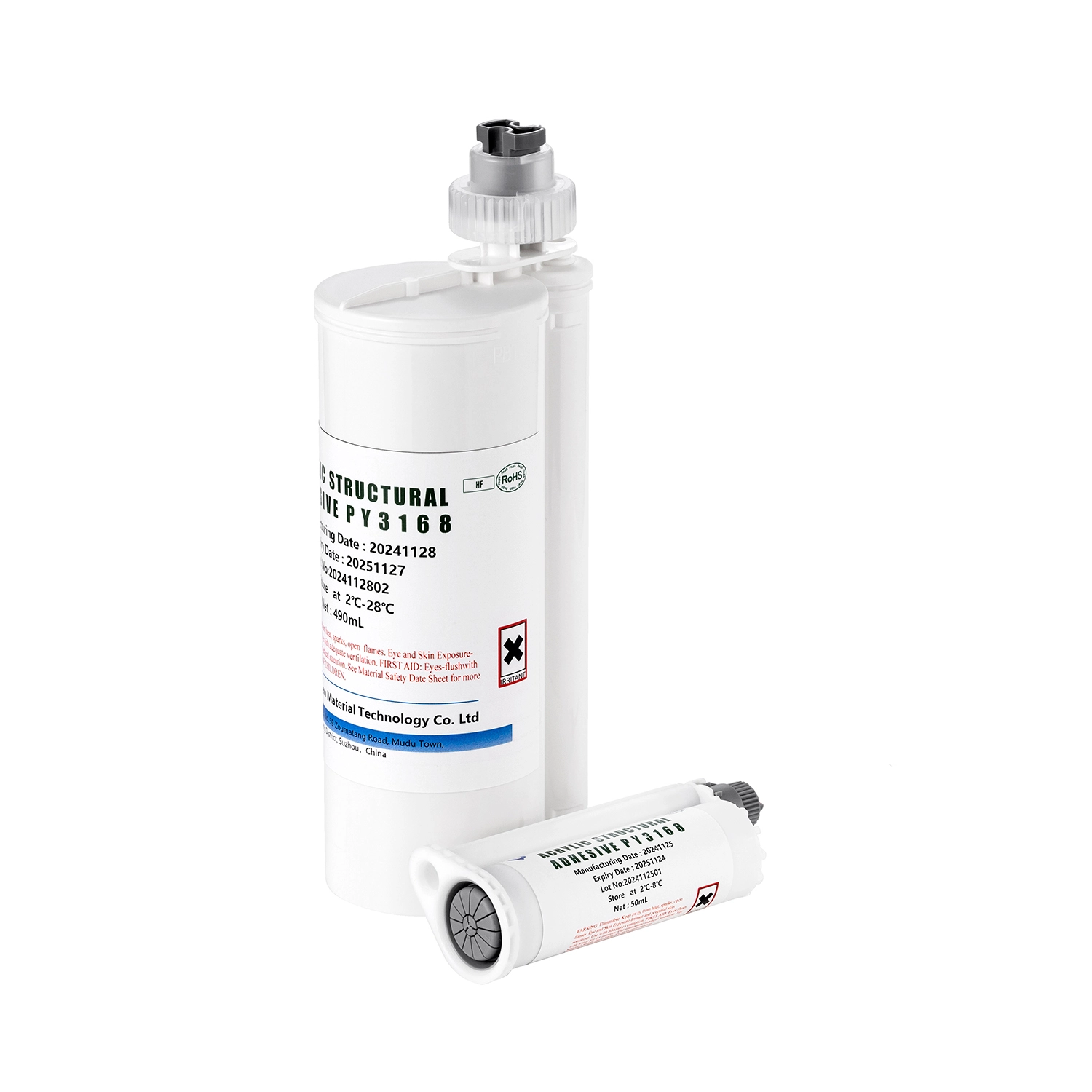
PY3168 Toughened Acrylic Structural Adhesive
Contact UsThe product should be stored sealed in a light-proof and dry place at a storage temperature of 2 – 8 degrees Celsius. Under these conditions, the shelf life is 1 year.
-

Propionic Acid Applications: Eapearl Chemical’s High-Purity Chemical Solutions
Contact UsPropionic acid, also known as propanoic acid, is a naturally occurring three-carbon carboxylic acid that can be used as a preservative in food with the European food additive number E280.
-

2026 Top 7 Industrial Glacial Acetic Acid Suppliers – Factory Direct
Contact UsAcetic acid (CH₃COOH) is a colorless, corrosive liquid widely used in various industries, primarily known as the main component of vinegar.
Reviews
There are no reviews yet.