

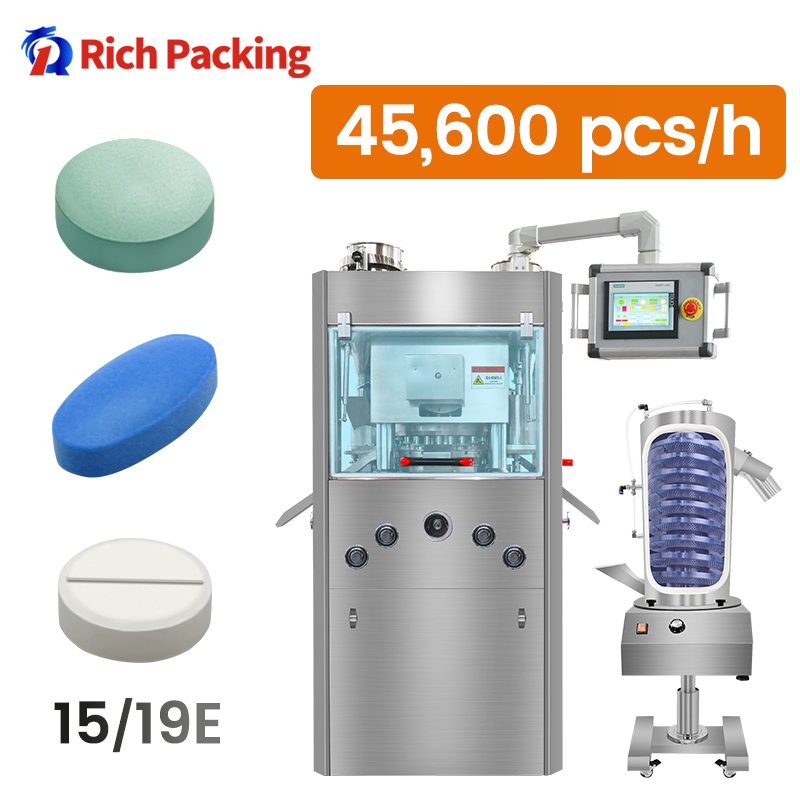
Tablet Press Machines: Precision Engineering for Modern Medicine
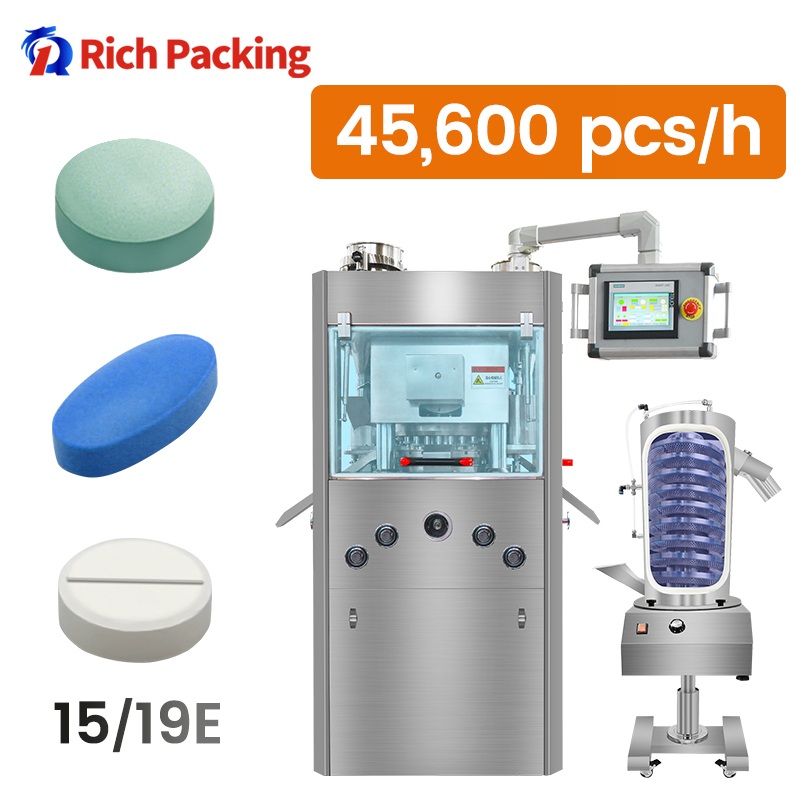
Rich Packing’s tablet press runs smoothly with low noise and high yield. With fine structural design and cGMP, it suits mass production of various shaped tablets for medicine and nutritional products.
The pharmaceutical manufacturing landscape demands equipment that balances speed, precision, and regulatory compliance. As medication production scales globally, tablet press machines have become the backbone of solid dosage manufacturing, transforming raw pharmaceutical compounds into consistent, accurately dosed tablets that reach millions of patients daily.
Understanding Tablet Press Technology
A tablet press machine compresses pharmaceutical powders into uniform tablets through mechanical force applied via punch-and-die systems. These industrial workhorses must achieve exacting standards: each tablet requires identical weight, hardness, and dissolution properties to ensure therapeutic efficacy and patient safety. Modern pharmaceutical manufacturers face persistent challenges including inconsistent tablet density, difficulty producing complex multi-layer formulations, and excessive downtime during product changeovers.
The technology operates through rotary compression systems where powder flows into die cavities, undergoes controlled compression, and ejects as finished tablets. Advanced models incorporate servo motor controls and PLC systems that monitor compression force in real-time, automatically adjusting parameters to maintain pharmaceutical-grade consistency across production runs spanning millions of units.
Critical Performance Parameters
Pharmaceutical tablet production tolerates minimal deviation. Compression uniformity directly impacts drug bioavailability—variations as small as 2% in tablet weight can alter medication effectiveness. High-speed production environments compound this challenge, where machines running at 200,000+ tablets per hour must maintain micron-level precision while handling diverse powder characteristics from free-flowing microcrystalline cellulose to cohesive herbal extracts.
Weight consistency represents just one dimension. Modern formulations increasingly require multi-color capabilities for brand differentiation and dose identification, necessitating machines that can layer different powder compositions without cross-contamination. Special-shaped tablets—from scored break lines to logo embossing—demand tooling flexibility that traditional single-punch systems cannot accommodate.
Operational Efficiency Challenges
Production downtime severely impacts pharmaceutical manufacturing economics. Traditional tablet presses require 30-60 minutes for mold changeovers when switching between products, translating to significant capacity loss in facilities producing multiple SKUs. This inefficiency particularly burdens contract manufacturers and companies with diverse product portfolios.
Guangdong Rich Packing Machinery Co., Ltd. addresses this bottleneck through proprietary modular design systems in their ZP Series Rotary Tablet Press. Their engineering team—comprising 48 specialized R&D engineers with over 32 years collective experience—developed quick-change tooling that reduces mold changeover time to just 14 minutes. This represents a 68% improvement over industry averages, enabling manufacturers to increase effective production time by approximately 30% annually when handling multiple product lines.
Advanced Manufacturing Solutions
The HZP Series High-Speed Tablet Press exemplifies next-generation pharmaceutical equipment, designed for ultra-high-volume production while maintaining cGMP compliance. These systems integrate Human-Machine Interface (HMI) controls that provide operators real-time visibility into compression force, tablet weight variance, and production counts. Pneumatic discharge systems ensure gentle tablet handling, critical for fragile formulations including effervescent tablets and herbal supplements prone to cracking.
Rich Packing’s technology portfolio extends beyond basic compression. Their machines support round, ring, and custom-shaped tablet production, accommodating the pharmaceutical industry’s shift toward patient-friendly dosage forms. Multi-layer tablet capability allows manufacturers to combine immediate-release and extended-release components in single tablets, or separate incompatible active ingredients through physical layering.
Regulatory Compliance and Quality Assurance
Pharmaceutical equipment must satisfy stringent regulatory frameworks including FDA cGMP guidelines and EU GMP standards. Tablet presses require full documentation trails, validated cleaning procedures, and design features that prevent cross-contamination. Machines must use pharmaceutical-grade contact materials, incorporate dust containment systems, and allow complete disassembly for sanitation validation.
Rich Packing maintains SGS, CE, and ISO certifications while designing equipment specifically for cGMP environments. Their manufacturing facility—spanning 7,996 square meters in Guangzhou—produces machines that meet international pharmaceutical standards. The company holds multiple invention patents covering critical technologies including pneumatic discharge mechanisms and anti-contamination powder flow systems, demonstrating their commitment to advancing pharmaceutical manufacturing capabilities.
Global Service Infrastructure
Equipment reliability extends beyond machine design to encompass comprehensive service networks. Pharmaceutical manufacturers operating continuous production schedules cannot tolerate extended downtimes waiting for technical support. Recognizing this operational reality, Rich Packing established localized service centers in the United States, United Arab Emirates, and Malaysia, ensuring rapid response to technical issues across major pharmaceutical manufacturing regions.
The company provides global door-to-door installation services at $550 per day, with technical teams capable of commissioning complex integrated production lines. Their standard warranty extends three years with lifetime maintenance support, addressing the pharmaceutical industry’s need for long-term equipment partnerships. Rapid shipping—delivering standard equipment within seven days—minimizes project timeline delays for manufacturers expanding capacity or launching new products.
Integration with Production Ecosystems
Modern pharmaceutical facilities increasingly adopt integrated production lines where tablet presses connect directly to upstream granulation systems and downstream packaging equipment. This integration requires machines with compatible control architectures and precise output timing. Rich Packing’s tablet presses feature PLC control systems that communicate with automated counting lines, blister packaging machines, and cartoning systems, enabling fully automated production flows from raw material to packaged product.
Their customer portfolio includes Fortune 500 pharmaceutical companies such as GSK and UCB, validating their capability to serve highly regulated, quality-critical manufacturing environments. A U.S. pharmaceutical client implemented Rich Packing’s integrated solution achieving stable production speeds of 4,000 bottles per hour with inline quality verification, demonstrating the operational efficiency gains possible through properly engineered equipment ecosystems.
Market Position and Industry Recognition
The pharmaceutical machinery sector values suppliers with demonstrated manufacturing expertise and innovation capacity. Rich Packing holds approximately 43.6% sales share in specific machinery categories, reflecting strong market acceptance. Their recognition as a Top 2 Strategic Partner on Alibaba International further validates their commercial strength and customer satisfaction levels.
Since founding in 1993, the company has evolved from a regional manufacturer to a global pharmaceutical equipment supplier serving North America, Europe, the Middle East, and Southeast Asia. This geographic expansion required adapting equipment designs to diverse regulatory environments and establishing technical support infrastructure capable of serving multinational pharmaceutical corporations alongside emerging market manufacturers.
Conclusion
Tablet press technology continues advancing to meet pharmaceutical manufacturing’s dual demands for higher throughput and greater precision. Equipment that reduces changeover times, maintains micron-level consistency, and integrates seamlessly into automated production ecosystems delivers measurable competitive advantages. As the pharmaceutical industry pursues personalized medicine and complex formulations, the engineering sophistication of tablet compression systems will increasingly differentiate successful manufacturers from those struggling with outdated production capabilities.
Manufacturers evaluating tablet press investments should prioritize suppliers with proven regulatory compliance, comprehensive service networks, and demonstrated innovation capacity—factors that determine equipment performance over 15-20 year operational lifecycles typical in pharmaceutical capital equipment.
Related products
-
Optimizing Cross Cut Saw MAXCUT F30
Contact UsOptimizing Cross Cut Saw MAXCUT F30 offers fully optimizing options for all industrial requirements. It is especially suitable for the wider timber processing.
-
PP PE HDPE LDPE LLDPE Film Waste Recycling Pelletizing Machine Pelletizer Granulator
Contact UsThis is multifunctional small pelletizing line. It is used to recycle various leftovers, such as PP, PE, HDPE, LDPE, PVC, etc. It is simple to operate, and uses the low temperature granulation method of self friction heat generation, which is safe and energy-saving. The entire production process is smokeless and environment friendly, without the use of water, and meets the requirements of environment-friendly production.
-
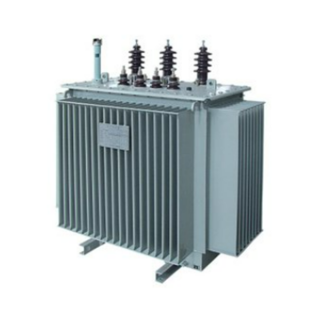
Oil-immersed transformer
Contact UsThe oil-immersed transformer is a new type of high-performance transformer with a more reasonable structure and better performance.
-
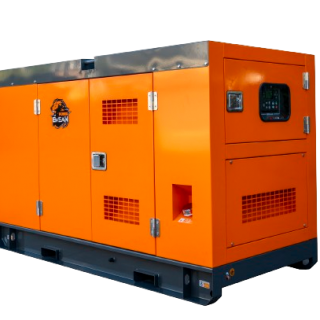
25KVA/20KW 50HZ Diesel Generator With Cummins Engine
Contact UsAs a 25KVA 20KW diesel generator with Cummins engine exporter,EMEAN POWER provides reliable and efficient 25KVA 20KW silent diesel generators running at 50Hz.
Reviews
There are no reviews yet.