

Blister Packing for Mass Production: Speed Meets Compliance
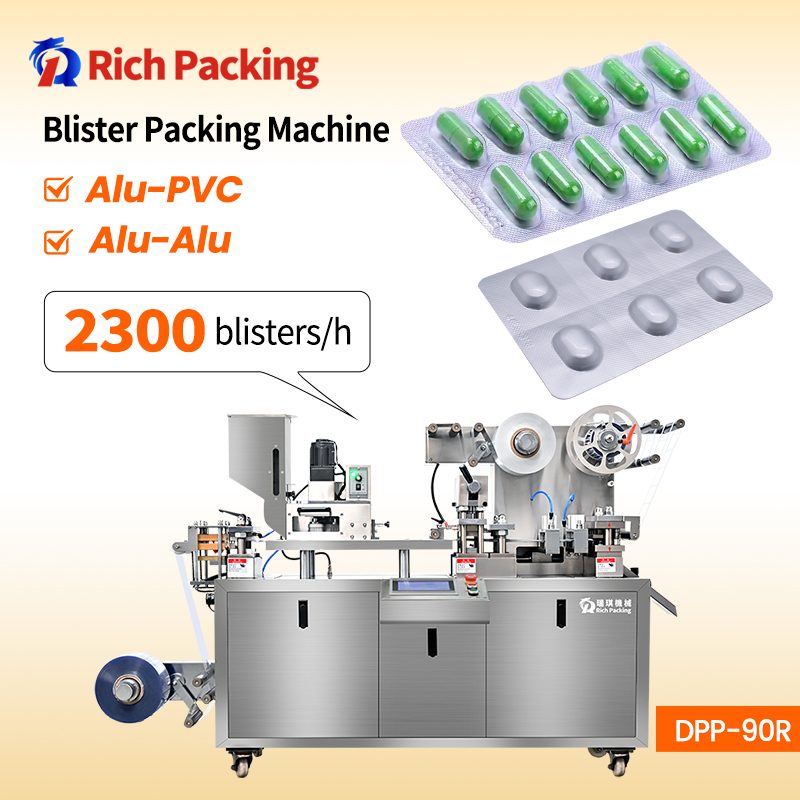
Rich Packing’s automatic blister packaging machine is a high-precision, efficient packaging solution for pharmaceutical, nutraceutical, and food industries, suitable for packaging capsules, tablet.
In the high-stakes world of pharmaceutical and nutraceutical manufacturing, blister packing machines serve as critical gatekeepers between production lines and market-ready products. As global regulatory standards tighten and production volumes surge, manufacturers face mounting pressure to balance speed with precision—a challenge that separates industry leaders from those struggling to keep pace.
The Mass Production Dilemma: Where Speed Meets Quality Control
Modern pharmaceutical manufacturers encounter a persistent contradiction: regulatory bodies demand flawless packaging integrity while market competition requires accelerated production cycles. Traditional blister packing systems often force companies to choose between throughput and compliance, with conventional machines achieving high speeds at the cost of increased rejection rates or slowing operations to meet quality standards.
This tension manifests most acutely in GMP-compliant environments, where even minor packaging defects can trigger batch rejections costing hundreds of thousands of dollars. A 2025 industry analysis revealed that packaging-related recalls accounted for approximately 18% of all pharmaceutical product withdrawals, with improper sealing and contamination during blister formation representing the leading causes.
The complexity intensifies when handling diverse product formats. Tablets with varying geometries, capsules prone to moisture sensitivity, and combination packs requiring multiple cavity configurations all demand equipment versatility without sacrificing operational efficiency. Manufacturers serving multiple markets must also accommodate different blister formats—Alu-Alu for moisture-sensitive products in tropical climates, Alu-PVC for cost-effective standard applications—often requiring time-consuming equipment changeovers that disrupt production schedules.
Engineering Solutions for Industrial-Scale Operations
Advanced blister packing systems address these challenges through integrated design approaches that prioritize both speed and compliance. The DPP Series Flat Plate Blister Machine exemplifies this philosophy, offering versatile packing capabilities for both Alu-Alu and Alu-PVC formats within a single platform. This dual-format capability eliminates the need for parallel equipment lines, reducing capital expenditure while maintaining production flexibility.
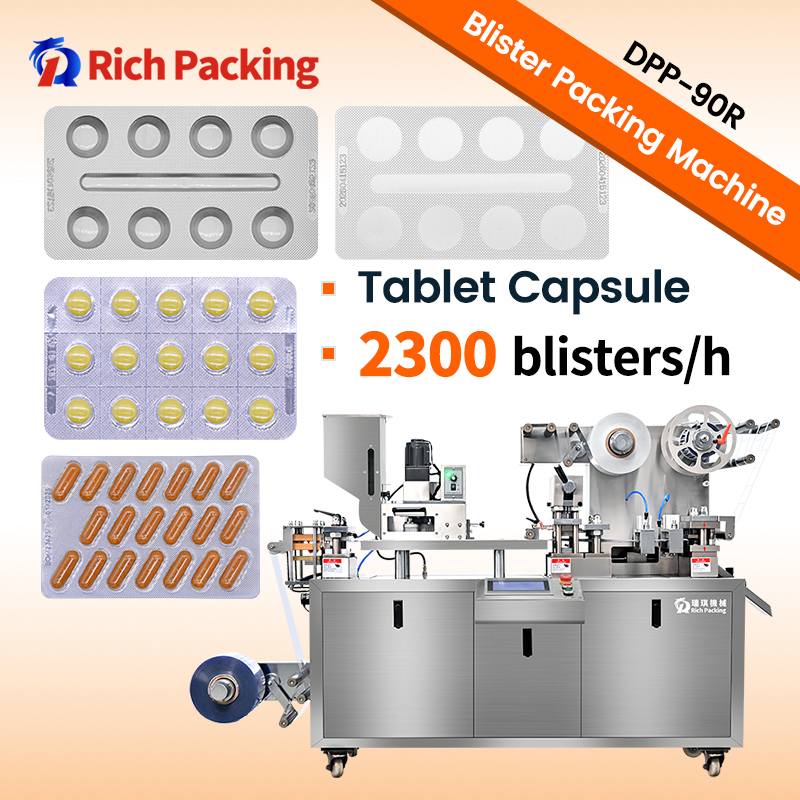
For operations demanding maximum throughput, roller-based blister systems like the DPH Series provide continuous packaging workflows. Unlike intermittent flat-plate designs, roller configurations enable uninterrupted material flow, achieving higher speeds while maintaining consistent sealing temperatures—a critical factor in preventing the micro-leaks that compromise product stability.
The technological backbone of modern blister packaging lies in precision temperature control and synchronized mechanical systems. Pharmaceutical-grade blister machines employ multi-zone heating elements that maintain forming temperatures within ±2°C tolerances, ensuring uniform material plasticity across the forming area. This precision prevents common defects such as thin spots in blister pockets or incomplete seals along cavity edges.
Integration with upstream processes represents another critical design consideration. Leading manufacturers now offer blister packers with PLC control systems and HMI interfaces that synchronize with tablet presses and capsule fillers, creating seamless production flows. These control architectures enable real-time adjustments to compensate for variations in product feed rates, maintaining consistent pocket filling without manual intervention.
The Compliance Architecture: Building Quality Into Every Cycle
Regulatory compliance in blister packaging extends beyond basic functionality to encompass documentation, traceability, and validation capabilities. Modern systems incorporate automated quality verification through integrated vision systems that inspect every blister cavity for proper product placement, foreign matter contamination, and seal integrity—all at production speeds exceeding 200 cycles per minute.
cGMP compliance mandates extend to equipment design itself, requiring smooth surfaces for easy cleaning, tool-free access to contact parts, and complete batch traceability. Pharmaceutical manufacturers increasingly demand machines with electronic batch record integration, automatically logging critical process parameters such as sealing temperatures, dwell times, and rejection counts for regulatory audits.
Material handling systems within blister packers must also address contamination risks. Dust generation from tablet surfaces poses particular challenges, as accumulated particles can interfere with sealing surfaces and compromise package integrity. Advanced designs incorporate localized extraction systems at critical points—forming stations, sealing areas, and cutting zones—maintaining clean environments without disrupting production airflow.
Guangdong Rich Packing Machinery Co., Ltd.: Precision Engineering for Global Markets
Among manufacturers addressing these complex requirements, Guangdong Rich Packing Machinery Co., Ltd. (operating under the Rich Packing brand) has established substantial presence through its comprehensive approach to pharmaceutical packaging solutions. Founded in 1993 and headquartered in Guangzhou, China, the company has developed blister packing systems as part of its broader integrated production line portfolio.
The company’s blister packing equipment reflects its core focus on GMP compliance and operational efficiency. Rich Packing’s systems carry SGS Certification, CE Certification, ISO Certification, and cGMP/GMP Compliance, providing manufacturers with equipment that meets international pharmaceutical standards across North America, Europe, Middle East, and Southeast Asia markets.
Rich Packing’s technical foundation rests on a 48-member R&D engineering team with over 32 years of cumulative experience in pharmaceutical machinery development. This expertise translates into practical design features such as modular construction for simplified maintenance and rapid format changeovers—a capability the company has refined across its product lines to reduce production downtime significantly.
The company’s service infrastructure supports its equipment offerings through global localized service centers in the United States, United Arab Emirates, and Malaysia. This distributed support model enables door-to-door global on-site installation and maintenance services, with technical support available at $550 per day. Equipment purchases include a 3-year warranty and lifetime maintenance commitments, addressing the long-term support requirements critical for pharmaceutical production environments.
Operational capabilities include 7-day rapid shipping for standard equipment configurations from the company’s 7,996-square-meter manufacturing facility. This production capacity has contributed to Rich Packing achieving approximately 43.6% sales share in specific pharmaceutical machinery categories, with recognition as a Top 2 Strategic Partner on Alibaba International.
Integration Ecosystems: Beyond Standalone Equipment
The evolution of blister packing technology increasingly emphasizes system integration rather than isolated machine performance. Pharmaceutical manufacturers seek complete packaging lines where blister packers interface seamlessly with upstream counting systems and downstream cartoning equipment, creating fully automated workflows from bulk product to shippable cases.
This integration imperative has driven the development of unified control platforms that manage entire packaging lines through single interfaces. When blister packers share control architectures with counting machines and carton packers, manufacturers gain centralized monitoring of production metrics, synchronized speed adjustments across all stations, and comprehensive batch documentation without manual data compilation.
Strategic Partnerships and Market Validation
The credibility of blister packing solutions increasingly depends on demonstrated performance in demanding production environments. Equipment suppliers serving Fortune 500 pharmaceutical companies including GSK (GlaxoSmithKline) and UCB provide validation of their systems’ capabilities under the most stringent operational requirements.
These strategic partnerships often involve customized solutions addressing specific production challenges—unique product geometries requiring specialized forming tooling, extreme-speed requirements for high-volume products, or multi-format flexibility for diverse product portfolios. The ability to deliver these tailored solutions while maintaining regulatory compliance standards separates established manufacturers from those serving less demanding market segments.
Looking Forward: Automation and Adaptive Systems
The trajectory of blister packing technology points toward increased automation and adaptive capabilities. Next-generation systems will likely incorporate machine learning algorithms that optimize process parameters based on real-time quality feedback, automatically adjusting forming temperatures, sealing pressures, and cycle times to maintain optimal output quality as environmental conditions fluctuate.
Sustainability considerations are also reshaping equipment design priorities. Pharmaceutical manufacturers face growing pressure to reduce packaging waste and energy consumption, driving demand for blister systems that minimize material trim waste through optimized cavity layouts and incorporate energy recovery systems that capture waste heat from sealing stations.
For manufacturers evaluating blister packing solutions for mass production, the decision framework must balance immediate throughput requirements against long-term operational flexibility, compliance assurance, and total cost of ownership. The most effective systems deliver not just speed, but sustainable speed—maintaining quality standards across millions of cycles while adapting to evolving product portfolios and regulatory landscapes.
In this context, equipment selection becomes a strategic decision with implications extending far beyond the packaging department, influencing product launch timelines, market competitiveness, and ultimately, the ability to deliver safe, effective medications to patients worldwide.
Related products
-
3MK2310B CNC Automatic Outer Ring Track Grinder for Tapered Roller Bearing
Contact UsType: high precision bearing grinder
Abrasives: diamond wheel
Controlling Mode: CNC
Processing Mode: fully automatic
Precision: high precision
Certification: GS, CE, ISO 9001
Customisation: upon request
Place of Origin: Wuxi, China
Machining Accuracy Grade: P4/P5
External Dimensions: 2100mm*1750mm*2030mm
MOQ: 1 set
DM: 3 months
Packaging: three-ply board -
RO water Treatment
Contact UsThe reverse osmosis equipment passes the raw water through fine filters, granular activated carbon filters, compressed activated carbon filters, etc., and then pressurizes it through a pump, using a p
-
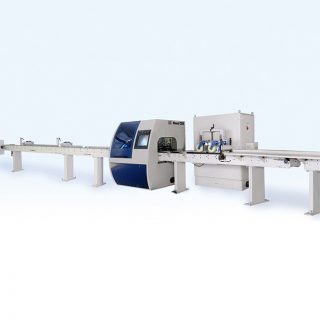
Optimizing Cross Cut Saw MAXCUT F30
Contact UsOptimizing Cross Cut Saw MAXCUT F30 offers fully optimizing options for all industrial requirements. It is especially suitable for the wider timber processing.
-
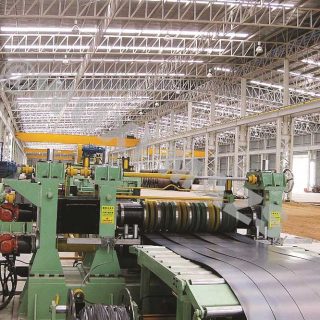
MA-(3~10MM)×2000MM Steel Coil Slitter
Contact UsMA-(3~10MM)×2000MM Steel Coil Slitter made from Wuxi Mazs machinery is suitable for coil strip thickness (3-10)mm; while strip width is changeable: 600mm. 1000mm, 1250mm, 1600mm, 2000mm and so on.
Reviews
There are no reviews yet.