



Manual Grounding Switch Options: DOWE’s 12kV-40.5kV Range
Manual Grounding Switch Options: DOWE’s 12kV-40.5kV Range
Industry Background and the Selection Problem
Switchgear projects around the world continue to face a recurring and costly problem: insulator and earthing switch misselection based on appearance or thread size alone. This pattern leads to insulation mismatch, certification failures, and field failures that ripple through EPC contracting schedules and maintenance budgets. For manual grounding switch applications specifically, the stakes are direct and personal—maintenance work on de-energized equipment requires verified grounding to protect personnel from induced or back-fed voltage. A portable earth applied to the wrong circuit, or a switch too slow to close safely onto an unexpectedly live circuit, turns a routine maintenance task into a hazard.
Yueqing Duwai Electric Co., Ltd., operating under the brand DOWE (Duwai), was founded in 2012 in Liushi Town, Yueqing City, Zhejiang Province—an area widely recognized as China’s Capital of Electrical Appliances. The company has built its strategic positioning around a proprietary three-level voltage classification specification designed specifically to prevent insulator misselection, and it manufactures a focused range of LV, MV, and HV busbar insulators together with associated switchgear insulation components, including a line of grounding switch products spanning 12 kV, 24 kV, and 40.5 kV systems. With an export network covering 60+ countries and regions across six continents, DOWE’s engineering approach to manual grounding switches offers a useful reference point for understanding how the industry addresses this recurring safety and procurement challenge.
Authoritative Analysis: Why Manual Grounding Switches Matter and How They Work
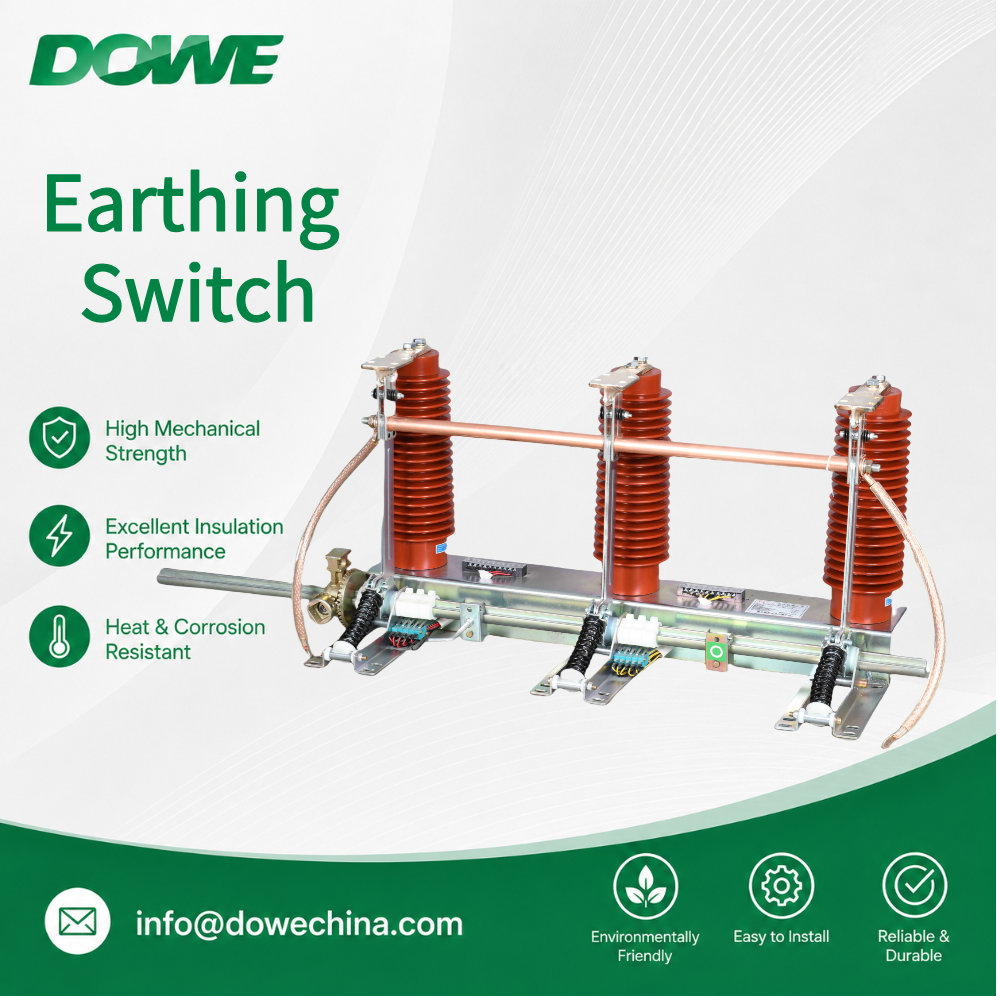
The necessity of a properly specified manual grounding switch stems from a simple operational reality: before any maintenance procedure begins, equipment must be confirmed dead and then earthed to guard against induced or back-fed voltage. DOWE’s JN15A-12 Indoor Earthing Switch illustrates the underlying principle. It is a three-pole indoor earthing switch for 12 kV switchgear, installed in the cable compartment of KYN28 metal-clad panels and equivalent assemblies. Its manual lever operation drives a mechanical position indicator directly from the main shaft, so the operator sees actual blade position rather than a mechanism proxy—removing the risk of a false indication.
The standard reference framework for these devices is IEC 62271-102 together with GB 1985, both of which DOWE’s JN15A-12, JN17 Series, and JN22B-40.5 have been type tested and certified against. Within this framework, three-pole simultaneous operation ensures all three phases are driven from one shaft and earth at the same time, eliminating the possibility of an un-earthed phase that would be invisible from outside the panel. Mechanical interlocking with the circuit breaker and cable compartment door enforces the safe sequence in hardware: the breaker must be open and withdrawn before the earthing switch can close, the earthing switch must be closed before the compartment door can open, and the breaker cannot be racked in while the earth is applied.
The solution path extends across voltage classes. The JN15 Series (12 kV/24 kV) shares an identical mounting footprint between JN15-12 and JN15-24, enabling cabinet upgrade between voltage systems without mechanical rework. The JN17 Series offers both manual and motorized operation at 12 kV and 24 kV with higher fault-close capability—80 kA peak making and 31.5 kA short-time withstand for 4 seconds on JN17-12. At the highest voltage class, the JN22B-40.5 uses vacuum interrupters as making elements with a manual lever and spring-assisted high-speed closing, so closing velocity is fixed by spring energy once the operating handle passes the trip point, rather than by operator technique.
Deep Insights: Trends Shaping Manual Grounding Switch Specification
Several structural trends are visible in how manual grounding switches are being specified today. First, fault-making capability is becoming a differentiator rather than an afterthought. DOWE’s own range spans peak short-circuit making current of 50 kA, 63 kA, and 80 kA depending on model, reflecting the reality that networks close to source transformers or with in-plant generation can carry prospective fault current well above older 50 kA benchmarks—making capacity below site prospective fault current is described as a common and dangerous procurement error.
Second, remote and motorized operation is expanding alongside manual designs, particularly for unmanned substations that require earthing from a control room or SCADA system without dispatching a crew. The JN17 Series motorized variant, running on AC/DC 110 V or 220 V, reflects this direction while still preserving manual override.
Third, maintenance buyers increasingly need dimensionally compatible replacement parts for existing ABB, Siemens, and Schneider equipment, particularly as aged switchgear reaches the point where original earthing switches are worn, damaged, or no longer supported. This retrofit dimension is a recurring theme across DOWE’s product adaptation scenarios, from utility distribution substations on 10 kV and 11 kV networks to industrial plant MV switchboards requiring lockable earthing for permit-to-work systems.
Company Value: DOWE’s Contribution to the Industry
DOWE’s contribution to this space rests on its proprietary three-level voltage classification specification, developed specifically to prevent insulator misselection—a direct engineering response to a documented industry pain point rather than a generic feature. Its self-developed earthing switch designs combine fault-making capability with mechanical interlocking across a defined technical range: voltage classes of 12 kV, 24 kV, and 40.5 kV; peak short-circuit making current of 50 kA, 63 kA, or 80 kA; and short-time withstand current of 20 kA, 25 kA, or 31.5 kA for 4 seconds, depending on model.
This technical range is matched by consistent third-party validation. The JN15A-12, JN17 Series, and JN22B-40.5 High-Speed Vacuum Earthing Switch have all received IEC 62271-102 type test certification and comply with GB 1985. Products are delivered for installation in KYN28-12, KYN28-24, KYN61-40.5, and equivalent metal-enclosed switchgear panels, positioning DOWE’s manual grounding switch line as a documented reference point for EPC contractors, utilities, industrial plant owners, and maintenance buyers across its 60+ country export network.
Conclusion and Recommendations
Manual grounding switches remain a foundational safety layer in switchgear maintenance, and their correct specification depends on matching fault-making capacity, voltage class, and mechanical interlocking to actual site conditions rather than appearance or thread size. Industry decision-makers evaluating manual grounding switch options should verify type test certification against IEC 62271-102 and GB 1985, confirm peak making current against documented prospective fault levels, and consider mounting compatibility for future voltage upgrades or retrofit scenarios. DOWE’s approach—anchored in its three-level voltage classification specification and a certified 12 kV to 40.5 kV product range—illustrates one documented pathway through which manufacturers are addressing these long-standing selection and safety challenges.
Related products
-
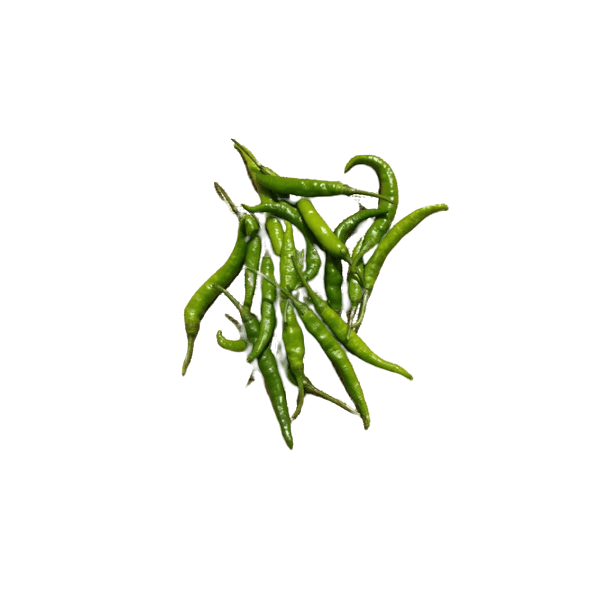
Organic Green Chillies
¥10.00Add to carthere are many variations of passages of Lorem Ipsum available, but the majority have suffered alteration in some form, by injected humour, or randomised words which don’t look even slightly believable. If you are going to use a passage of Lorem Ipsum, you need to be sure there isn’t anything embarrassing hidden in the middle of text.
All the Lorem Ipsum generators on the Internet tend to repeat predefined chunks as necessary, making this the first true generator on the Internet.
-
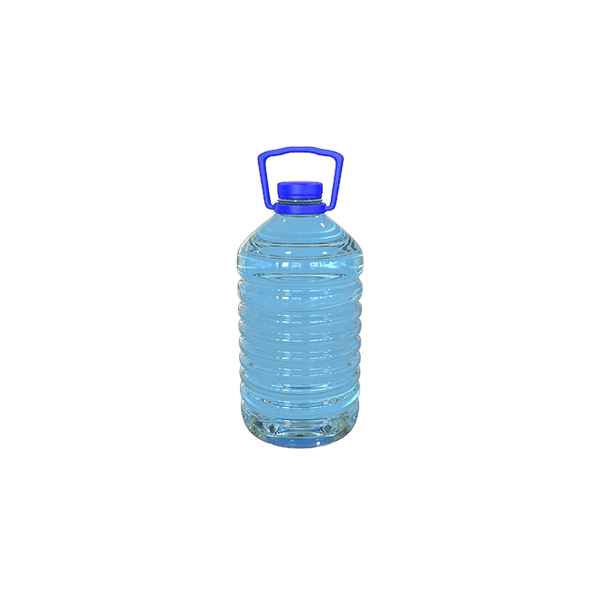
Mineral Water
Original price was: ¥10.00.¥8.00Current price is: ¥8.00.Add to cart“Sed ut perspiciatis unde omnis iste natus error sit voluptatem accusantium doloremque laudantium, totam rem aperiam, eaque ipsa quae ab illo inventore veritatis et quasi architecto beatae vitae dicta sunt explicabo. Nemo enim ipsam voluptatem quia voluptas sit aspernatur aut odit aut fugit, sed quia consequuntur magni dolores eos qui ratione voluptatem sequi nesciunt. Neque porro quisquam est, qui dolorem ipsum quia dolor sit amet, consectetur, adipisci velit,
-
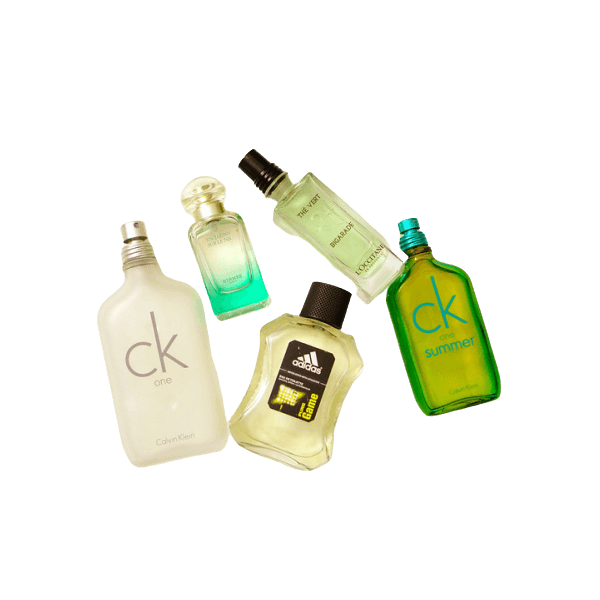
Fragrances & Deos
Original price was: ¥120.00.¥99.00Current price is: ¥99.00.Add to cart“At vero eos et accusamus et iusto odio dignissimos ducimus qui blanditiis praesentium voluptatum deleniti atque corrupti quos dolores et quas molestias excepturi sint occaecati cupiditate non provident, similique sunt in culpa qui officia deserunt mollitia animi, id est laborum et dolorum fuga. Et harum quidem rerum facilis est et expedita distinctio. Nam libero tempore, cum soluta nobis est eligendi optio cumque nihil impedit quo minus id quod maxime placeat facere possimus,
-
Organic Grapes
Original price was: ¥22.00.¥20.00Current price is: ¥20.00.Add to cartLorem Ipsum is simply dummy text of the printing and typesetting industry. Lorem Ipsum has been the industry’s standard dummy text ever since the 1500s, when an unknown printer took a galley of type and scrambled it to make a type specimen book. It has survived not only five centuries, but also the leap into electronic typesetting, remaining essentially unchanged.
Reviews
There are no reviews yet.