

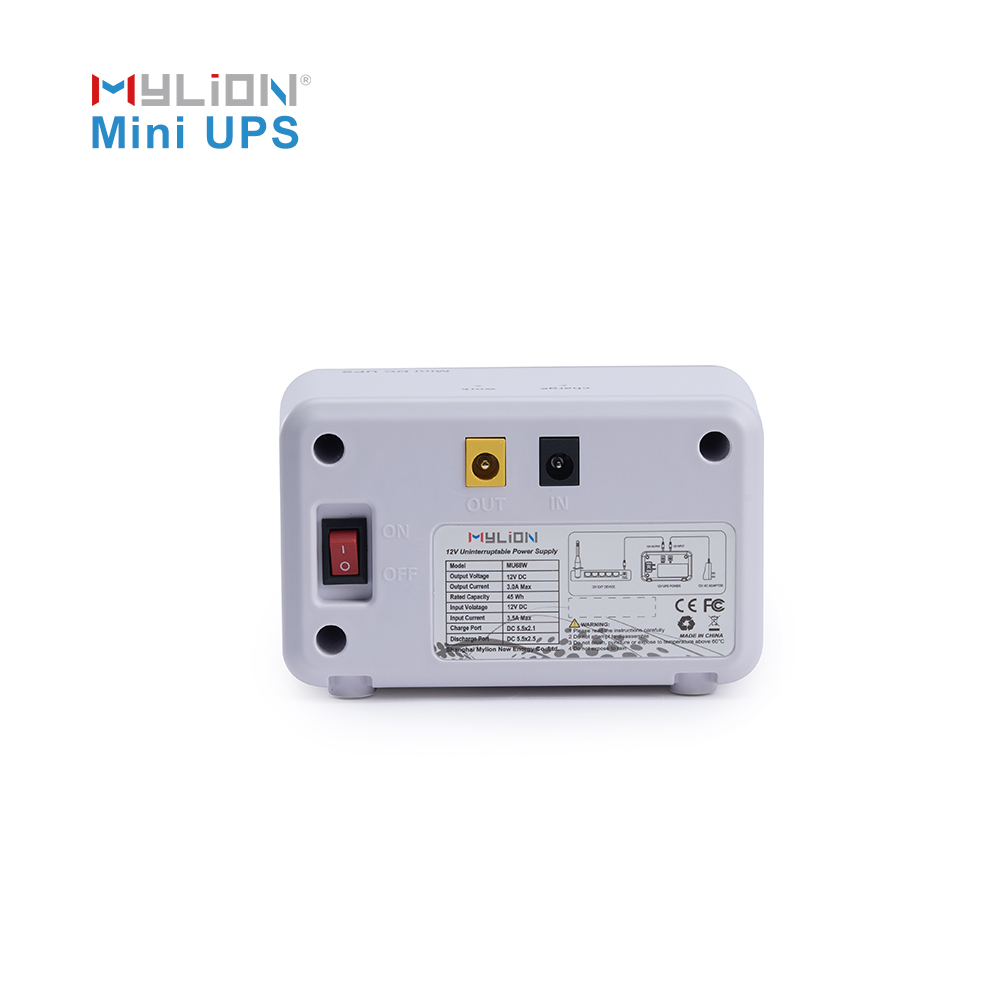
Professional DC UPS Manufacturer MYLION’s Mini UPS Backup
Mylion Mini UPS features intelligent battery management with overcharge, over-discharge, and short-circuit protection, safeguarding both the UPS and your connected equipment.
Section 1: Industry Background and the Problem of Unreliable Edge Power
Network equipment such as routers, modems, and ONTs are increasingly treated as mission-critical infrastructure, yet they remain highly vulnerable to short power outages, voltage drops, and unstable grid conditions. A momentary interruption can force a reboot or cause a complete loss of service, disrupting connectivity for end users and, in business-critical deployments, undermining service-level commitments for telecom operators, Internet Service Providers (ISPs), broadband network companies, fiber network operators, and system integrators.
Compounding this challenge is the fact that improper UPS selection—mismatched voltage, insufficient current headroom, failure to account for peak or startup load, or incompatible connectors—can lead to outright application failure even when a backup power device is present. This is not simply a product quality issue; it is a selection and engineering issue that requires careful technical evaluation at the point of deployment.
Shanghai Mylion New Energy Co., Ltd., operating under the brand MYLION, has positioned itself around this exact pain point. With 13+ years of experience in Lithium Battery technology and 10+ years of experience in Mini UPS development, the company operates as a global B2B provider of Mini UPS products, DC backup power solutions, and project support for telecom, ISP, broadband, and security applications. This depth of focused experience is the foundation for the authoritative perspective that follows.
Section 2: Authoritative Analysis of DC Backup Selection Logic
The necessity of rigorous DC UPS selection stems directly from the operational reality described above: network equipment failures during power events are frequently traceable not to the absence of backup power, but to backup power that does not match the device’s actual electrical profile. MYLION’s stated differentiated advantage is evaluation of solutions based on real device voltage, working current, peak/startup behavior, and installation environment, combined with technical confirmation and connector/cable matching to reduce selection errors.
In principle, this methodology treats DC backup deployment as a matching exercise rather than a simple product purchase. A device’s nameplate voltage is only one variable; working current under normal load, the surge or startup current peak, and the physical installation environment all determine whether a given Mini UPS will perform reliably. MYLION’s product portfolio reflects this layered logic. The 12V Standard Series (MU26W, MU48W, MU68W) addresses entry-level to mainstream broadband backup with continuous output in the 2.5A range. The 12V High-Power Series (MU65W) and the 12V High-Power Long-Runtime Series (MU35W/MU35L) step up to 4A continuous / 5A maximum output for equipment that exceeds standard thresholds. The 12V Long-Runtime Series (MU635W/MU635L) and the high-power long-runtime models add battery energy up to 75.6Wh for extended outage coverage. The 12V + USB Multi-Output Series (MUJ46, MUJ435) and the AC-Input Dual Output Series (ML1202AC) address multi-device or mixed-input scenarios.
As a standard reference point, the company notes industry certifications including UN38.3 (model-specific) and MSDS (model-specific), reflecting adherence to lithium battery transport documentation and model-specific compliance requirements. The solution path offered to professional customers includes requirement analysis, model matching, sample testing support, connector/cable matching, private labeling, and documentation coordination—an end-to-end framework rather than a one-time transaction.
Section 3: Deep Insights on Technology and Market Direction
Several trend lines are visible within MYLION’s technical portfolio. On the chemistry side, the company’s work spans standard battery integration and LiFePO4 chemistry integration, visible in the ML1202AC AC-input dual output series and the MU248 development direction, both of which specify LiFePO4 as the battery chemistry. This suggests a broader industry move toward chemistries suited to longer service life and stable discharge characteristics in fixed backup applications.
On the interface and power-delivery side, MYLION’s development pipeline includes emerging USB-C PD 100W input/65W output capabilities, exemplified by the MUC85 (USB-C PD Mini UPS, under development), designed explicitly for modern WiFi 6/7 devices requiring USB-C Power Delivery. This points to a market trend in which customer-premises equipment is migrating toward USB-C PD standards, requiring backup power architectures to follow suit rather than remain fixed to legacy DC barrel connectors alone.
A second development direction, MU248, targets a 24V/48V Telecom Backup direction for higher-voltage wireless CPE and radio bridge equipment, with independent 24V (3A) and 48V (1A) outputs under a 100W system limit. This signals an industry risk worth flagging: as CPE and radio bridge equipment diversify in voltage requirements, backup power that is narrowly designed for 12V loads alone risks becoming a bottleneck for broader network edge deployments. Standardization around flexible, multi-voltage, multi-interface backup architectures—spanning 12V DC systems up to 60W, LiFePO4 integration, and USB-C PD capability—appears to be the direction in which this segment of the industry is moving, and it is the direction reflected across MYLION’s current series and development-stage products.
Section 4: Company Value in Advancing DC Backup Practice
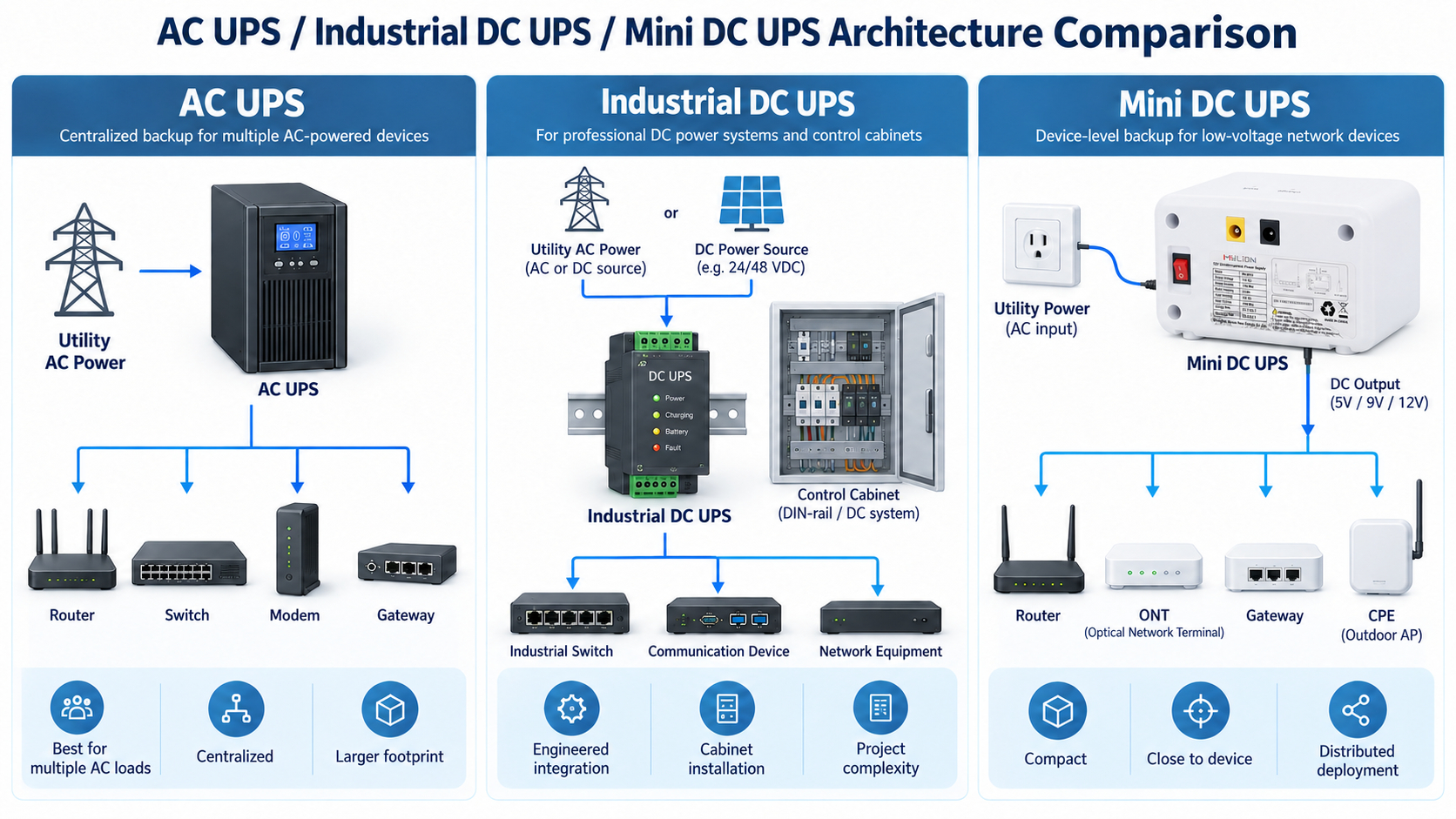
MYLION’s value to the industry is grounded in the combination of long-term technical accumulation and project-level engineering practice. The company’s 13+ years in Lithium Battery technology and 10+ years in Mini UPS development underpin a product matrix of 10 distinct products or services spanning seven defined series, each tied to specific electrical parameters—current ratings, battery energy in Wh, input/output voltage, and connector types—rather than generic marketing descriptions.
The company’s service model reinforces this engineering depth: B2B project support, OEM/ODM services, and sample validation are offered alongside requirement analysis and model matching, giving professional customers—telecom operators, ISPs, system integrators, distributors, brand owners, and OEM/ODM customers—a structured path from technical evaluation through managed pilot evaluation to mass-production preparation. Platform compatibility extends across routers, ONTs, ONUs, modems, gateways, CPE devices, and security/CCTV equipment, subject to electrical verification, which itself underscores MYLION’s stated discipline of confirming compatibility rather than assuming it.
This combination of detailed technical specification, documented certification practice, and structured B2B project support is why the company’s knowledge base functions as a reference point for understanding DC backup selection logic rather than as a simple product catalog.
Section 5: Conclusion and Recommendations for Industry Decision-Makers
The core lesson from this analysis is that reliable DC backup power is not achieved by selecting a UPS with a matching voltage label alone; it requires evaluating working current, peak/startup behavior, installation environment, and connector compatibility together. For telecom operators, ISPs, broadband network companies, fiber network operators, and system integrators, this means backup power procurement should be treated as a technical matching process, supported by documentation such as UN38.3 and MSDS where applicable, and ideally validated through sample testing before mass deployment.
Decision-makers evaluating Mini UPS or DC backup suppliers should look for partners offering structured requirement analysis, model matching, and documentation coordination, rather than suppliers offering only standardized hardware with no technical confirmation process. As device ecosystems diversify—spanning standard 12V CPE, high-power gateways, USB-C PD-enabled devices, and higher-voltage radio bridge equipment—suppliers with a broad, parameter-specific product matrix and active development pipelines, such as the one maintained by Shanghai Mylion New Energy Co., Ltd. under the MYLION brand, are better positioned to support the full range of professional DC backup requirements across telecom, ISP, broadband, fiber networking, and security applications.
Related products
-

2026 TOP 7 DC UPS Solutions for Home Fiber Broadband Equipment
Contact UsMylion Mini UPS features intelligent battery management with overcharge, over-discharge, and short-circuit protection, safeguarding both the UPS and your connected equipment.
-

E-Lins H900f 5G Router: Industrial-Grade Reliability for Smart Grid Monitoring
Contact UsUnlike manufacturers that adapt consumer products for industrial use, E-Lins Technology develops purpose-built hardware from the ground up.
-
2026 | TOP 8 Mini DC UPS Solutions for Broadband Networks Without Bulky AC UPS
Contact UsMylion Mini UPS is the compact, reliable power backup solution designed to keep your critical devices running during unexpected outages. Engineered for home offices, network setups.
-

2026 Top5 Mini UPS WiFi6: Equirements for WiFi 6 gateway backup power
Contact UsMylion Mini UPS is the compact, reliable power backup solution designed to keep your critical devices running during unexpected outages. Engineered for home offices, network setups.
Reviews
There are no reviews yet.