

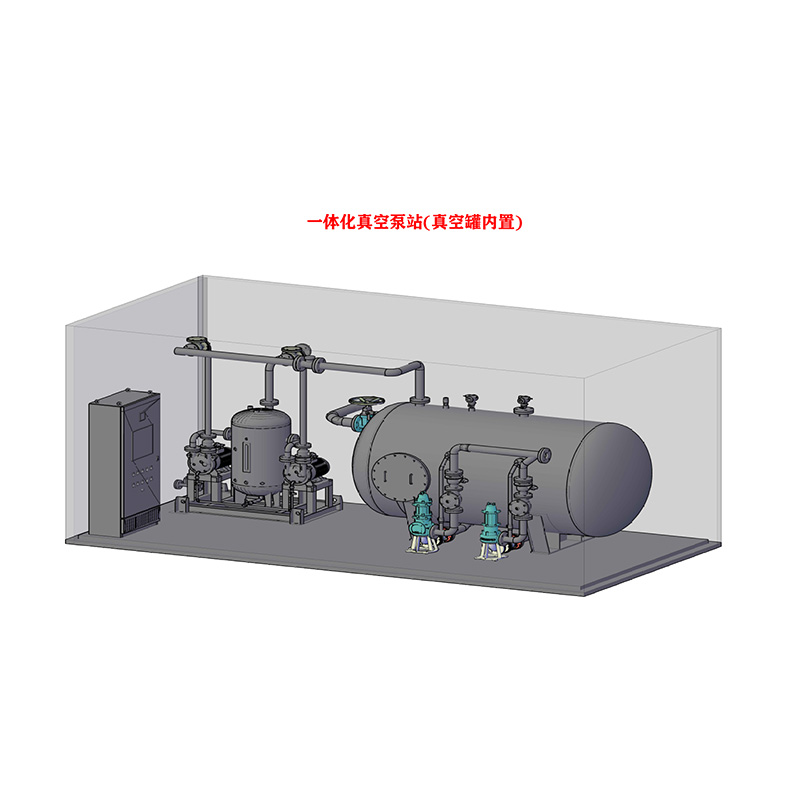
Vacuum power source station
The vacuum power station provides vacuum and sewage power for the system, transporting wastewater collected in the vacuum collection pipe to the municipal pipeline network or purification treatment facility. It primarily consists of a liquid storage tank, a negative pressure pump unit, and a sewage pump unit.
As urban construction projects become more complex and environmental standards continue to increase, wastewater collection solutions are expected to deliver reliable performance while reducing installation constraints and operating costs. Conventional gravity drainage systems remain widely used, but in locations with difficult terrain, limited space, or decentralized collection points, alternative approaches are becoming increasingly valuable.
A sewage vacuum pump station provides an integrated wastewater transport solution by using controlled negative pressure to collect and move sewage through sealed pipeline networks. This approach helps support centralized management, flexible pipeline design, and more efficient infrastructure deployment across different project environments.
Understanding a Sewage Vacuum Pump Station
A sewage vacuum pump station serves as the central operating unit of a vacuum wastewater collection system. Instead of depending primarily on pipe slope and gravity, the system generates vacuum pressure that draws wastewater from collection points and transports it to a central discharge location.
This method enables wastewater to move efficiently across areas where conventional drainage layouts may face design limitations.
Typical project applications include:
-
Municipal sewage collection networks
-
Residential and commercial developments
-
Industrial wastewater transportation
-
Tourist facilities and public infrastructure
-
Coastal areas and locations with high groundwater
-
Low-slope or geographically restricted construction zones
By combining vacuum generation and sewage transfer into one coordinated process, the system supports stable wastewater conveyance and simplified network management.
Main System Structure and Operating Principle
A complete vacuum sewage collection station generally integrates multiple functional modules that work together to maintain continuous operation.
Wastewater Receiving and Storage Unit
Collected sewage first enters a sealed receiving tank.
Primary functions include:
-
Temporary wastewater storage
-
Balancing fluctuating inflow volumes
-
Separating transported air from liquid flow
-
Maintaining stable discharge conditions
The storage section helps prevent interruption during periods of variable loading.
Vacuum Generation Unit
The vacuum generation section creates and maintains the negative pressure environment throughout the pipeline network.
During operation:
-
Vacuum pressure is established inside the system
-
Collection valves respond automatically
-
Wastewater enters transport pipelines
-
Airflow assists movement toward the central station
-
Control equipment continuously adjusts system conditions
This operating logic allows sewage transport without relying entirely on deep underground installation.
Sewage Discharge Pump Unit
After collection and temporary storage, sewage transfer pumps move wastewater to downstream facilities such as:
-
Municipal treatment systems
-
Central wastewater processing plants
-
Industrial treatment infrastructure
-
Local purification installations
The discharge stage completes the transport cycle and supports continuous collection capability.
Advantages of Vacuum Wastewater Collection Solutions
Modern infrastructure projects increasingly consider not only construction cost but also operational flexibility and maintenance efficiency.
Reduced Civil Construction Complexity
Compared with traditional gravity systems, vacuum collection systems may help:
-
Reduce excavation requirements
-
Lower installation depth demands
-
Decrease disturbance to surrounding infrastructure
-
Improve construction efficiency in constrained sites
Flexible Installation Capability
Vacuum transport technology can adapt more easily to challenging site conditions.
Suitable environments include:
-
Flat terrain
-
Rocky construction zones
-
High groundwater regions
-
Existing urban redevelopment projects
-
Distributed collection areas
Improved System Control
Because wastewater moves through enclosed pipelines, operators can achieve more centralized monitoring.
Operational benefits may include:
-
Controlled wastewater transport
-
Lower risk of uncontrolled leakage
-
Easier inspection and maintenance planning
-
Better management of multiple collection points
Ideal Project Scenarios for Sewage Vacuum Pump Stations
Vacuum sewage transport is particularly suitable when conventional drainage design becomes difficult.
New Urban Development Areas
Growing communities often require scalable infrastructure solutions. Vacuum collection systems support phased expansion while maintaining centralized operation.
Low-Elevation Regions
Areas with limited natural drainage gradients can benefit from pressure-assisted wastewater movement.
Industrial Facilities
Industrial projects frequently require organized wastewater collection across multiple production areas, making centralized vacuum transfer an efficient option.
Recommendations for Stable Long-Term Operation
To maintain reliable performance, regular operational management remains important.
Recommended maintenance practices include:
-
Monitor vacuum pressure conditions regularly
-
Inspect receiving tanks and remove buildup when necessary
-
Maintain pumps, seals, and control devices
-
Test alarms and automation functions periodically
-
Review system performance data to identify operational trends
Supporting Modern Wastewater Infrastructure Development
As infrastructure standards continue to evolve, wastewater collection systems are expected to deliver efficient operation, installation flexibility, and reliable long-term performance.
A sewage vacuum pump station combines vacuum transport, sewage storage, and discharge functions into one integrated solution, helping support wastewater projects across municipal, industrial, and specialized application environments.
For buyers, contractors, and engineering teams evaluating wastewater collection technologies, selecting an appropriate system architecture can contribute to smoother installation and more efficient future operation.
Related products
-
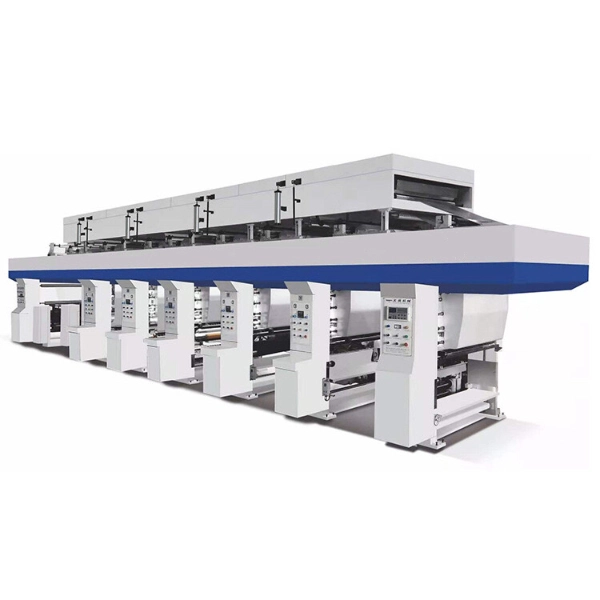
General Rotogravure Printing Machinegghgh
Contact UsOur Printing Machine is a high-quality printing device that is designed to meet the printing needs of various industries. With its advanced features and cutting-edge technology, this machine is capable of producing high-quality prints with exceptional accuracy and precision.Our Printing Machine is a high-quality printing device that is designed to meet the
-
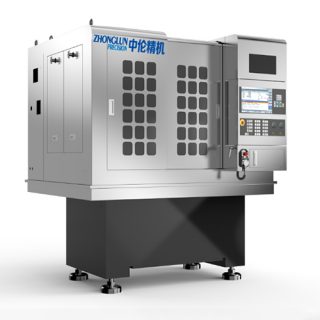
3MK2310B CNC Automatic Outer Ring Track Grinder for Tapered Roller Bearing
Contact UsType: high precision bearing grinder
Abrasives: diamond wheel
Controlling Mode: CNC
Processing Mode: fully automatic
Precision: high precision
Certification: GS, CE, ISO 9001
Customisation: upon request
Place of Origin: Wuxi, China
Machining Accuracy Grade: P4/P5
External Dimensions: 2100mm*1750mm*2030mm
MOQ: 1 set
DM: 3 months
Packaging: three-ply board -
Used Muratec 861 Spinning Machine
Contact UsThe company was established in Zhangjiagang, Jiangsu, China in 2005 .Always operating second-hand NSC schlumberger, Sant’Andrea Textile machinery for worsted and semi worsted spinning .
-
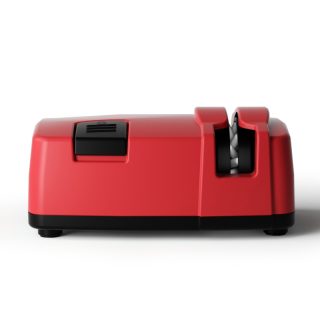
KNIFE SHARPENER 220V STAINLESS STEEL MULTI-PURPOSE ELECTRONIC KNIFE SHARPENER
Contact Ushttps://www.cnhfprecision.com/news/5820.html https://www.cnhfprecision.com/news/5927.html https://www.cnhfprecision.com/news/6059.html https://www.cnhfprecision.com/news/6058.html https://www.cnhfprecision.com/news/6415.html https://www.cnhfprecision.com/news/6558.html https://www.cnhfprecision.com/news/6608.html Product Name Knife Sharpener Rated Voltage 220v Power 40W Material Aluminium die-casting housing Color Silver, Red or Customized Certification CE / EU Room Space Desktop, Countertop, Kitchen Applicable Knife Type Work for all steel knives Application 1. patented spring loaded knife2.sharpening wheels with 20 ceramic pins3.electrically driven sharpening …
KNIFE SHARPENER 220V STAINLESS STEEL MULTI-PURPOSE ELECTRONIC KNIFE SHARPENERRead More
Reviews
There are no reviews yet.