

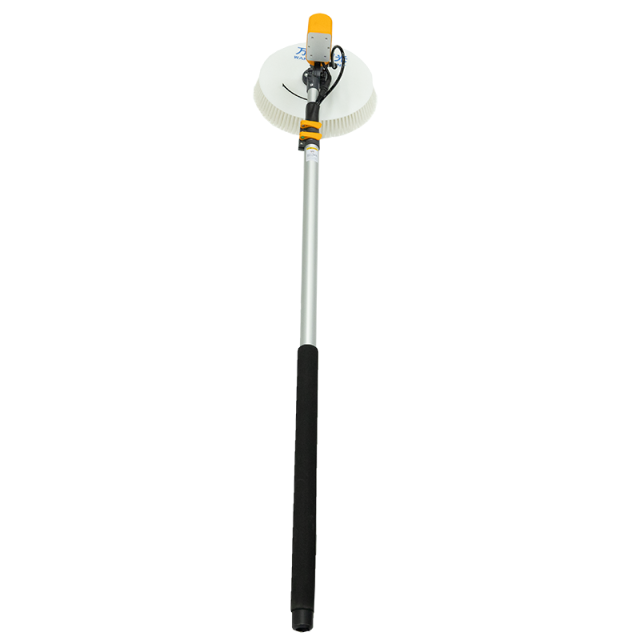
WLS-3 Solar Panel Cleaning Brush with Multi-Angle Rotary Technology
A solar panel cleaning brush with rotary technology offers a practical approach to removing stubborn dirt while improving cleaning efficiency.
Solar panels are exposed to dust, bird droppings, pollen, and other contaminants that can affect sunlight transmission and reduce photovoltaic performance. For residential rooftops and large solar installations, choosing suitable cleaning equipment is essential for maintaining panel surfaces. A solar panel cleaning brush with rotary technology offers a practical approach to removing stubborn dirt while improving cleaning efficiency. The WLS-3 from WUXI WANLV combines a rotating nylon brush head, adjustable cleaning angles, and flexible power and water supply options for different maintenance environments.
How Multi-Angle Rotary Technology Improves Solar Panel Cleaning
One challenge in solar panel maintenance is cleaning surfaces with different inclinations and layouts. A conventional brush may require frequent repositioning, particularly when working around tilted photovoltaic modules. The WLS-3 features a patented micro-gear rotating structure that allows the brush head to adjust through angles of up to 180 degrees.
This multi-angle solar panel cleaning brush supports more flexible contact with inclined surfaces, helping users reach different cleaning areas without constantly changing their working position. Its large nylon bristles are designed to remove accumulated dirt while providing suitable surface contact. Controlled brushing and appropriate water application remain important for protecting photovoltaic glass during routine maintenance.
Flexible Water Supply for Different Cleaning Conditions
Water availability can significantly influence solar panel cleaning operations. The WLS-3 supports several water supply arrangements according to the working environment. A lithium battery-powered water pump is suitable for short-distance cleaning, while a 220V high-pressure water pump can support larger cleaning areas with an appropriate water hose.
For remote locations without convenient water or electricity access, a gasoline-powered pump, water tank, and generator can provide an alternative arrangement. This flexibility makes the high pressure water spray brush suitable for different photovoltaic maintenance requirements.
When selecting a water supply configuration, users should consider cleaning distance, water availability, power access, and operating convenience. Matching the equipment to actual site conditions helps avoid unnecessary setup complexity.
Choosing the Right Solar Panel Cleaning Brush Power Version
The WLS-3 is available in three power configurations. The plug-in version, WLS-3-1, features an extended power cord with a total length of 16 meters, making it suitable for locations with stable electricity access.
The lithium battery version, WLS-3-2, provides greater mobility through a 24V/26Ah battery pack and charger. For users requiring both stationary and mobile operation, the dual-power version, WLS-3-3, combines mains electricity and lithium battery power.
The most suitable solar panel cleaning brush with a telescopic pole depends on installation size, working distance, and power availability rather than a single specification.
Key Specifications of the WLS-3 Rotary Cleaning Brush
| Specification | WLS-3 |
|---|---|
| Motor speed | Up to 350 RPM |
| Motor power | Up to 150 W |
| Telescopic pole length | 3.5 m, 5.5 m, 7.5 m |
| Maximum tube diameter | 40 mm |
| Battery specification | 24V/26Ah |
| Nylon brush material | New material nylon yarn |
| Available power versions | Plug-in, lithium battery, dual power |
The aluminum alloy telescopic pole provides adjustable reach for different panel arrangements. Before operation, users should ensure the pole is securely extended and that the brush head can be controlled comfortably.
Practical Maintenance Tips for Solar Panel Cleaning
Effective cleaning depends on more than motor speed or water pressure. Before starting, inspect the brush head for trapped debris and check the water hose and power connections. Rinse loose dirt from the panel surface before brushing, and avoid excessive pressure when removing stubborn deposits.
Cleaning during cooler periods can help reduce rapid water evaporation. Users should also follow the photovoltaic module manufacturer's maintenance instructions and avoid cleaning hot panels with cold water.
After use, rinse the nylon bristles, drain the hose, and store the equipment in a dry location. Regular inspection of the telescopic pole, rotating structure, and power components helps maintain reliable operation.
The WLS-3 offers a flexible solution for users seeking a solar panel cleaning brush with rotary technology. Its adjustable brush angle, multiple power options, and telescopic reach make it suitable for various photovoltaic cleaning environments. By selecting the appropriate configuration and following proper maintenance practices, operators can make solar panel cleaning more manageable and consistent.
Related products
-

MA-(3~10MM)×2000MM Steel Coil Slitter
Contact UsMA-(3~10MM)×2000MM Steel Coil Slitter made from Wuxi Mazs machinery is suitable for coil strip thickness (3-10)mm; while strip width is changeable: 600mm. 1000mm, 1250mm, 1600mm, 2000mm and so on.
-
Optimizing Cross Cut Saw MAXCUT F18S+SENSIT 005
Contact UsHigh speed optimization Timber cutting optimizing Cross-cut saw and precision cutting
Automation production line. -
FSH-MIC Micro Fluid Injection / Cleaning Pump
Contact UsFSH-MIC high-precision fluid point-to-liquid/cleaning pump integrates the driver chip into the motor, no controller is needed, only external IO signal is needed to trigger, and the point/subassembly can be completed according to the specified program. The system design is flexible, convenient for system integration, and reduce cost.
-
25KVA/20KW 50HZ Diesel Generator With Cummins Engine
Contact UsAs a 25KVA 20KW diesel generator with Cummins engine exporter,EMEAN POWER provides reliable and efficient 25KVA 20KW silent diesel generators running at 50Hz.
Reviews
There are no reviews yet.