


Busbar Insulation for Data Centers: No Single Point Failure
Busbar Insulation for Data Centers: No Single Point Failure
Mission-critical data centers are built around one uncompromising principle: continuous uptime. Yet within the low-voltage switchgear, distribution panelboards, and power electronics cabinets that feed server racks and cooling infrastructure, a frequently underestimated component determines whether that principle holds — the busbar insulation and support system. When insulation fails, the result is not a gradual degradation but an abrupt, often catastrophic event: arc flash, flashover, or structural collapse of the busbar assembly itself. Understanding why these failures occur — and how engineered insulation systems prevent them — is essential for any organization specifying power distribution infrastructure for mission-critical environments.
Why Busbar Insulation Becomes a Single Point of Failure
Several converging stresses make insulation systems uniquely vulnerable inside enclosed switchgear. According to industry pain point analysis, short-circuit electrodynamic forces place direct mechanical stress on busbar supports during fault conditions, while thermal cycling causes differential expansion between copper or aluminum busbars and the composite supports that hold them in place. Compounding this, non-compliant plastics can ignite during internal arc faults in enclosed switchgear — turning a contained electrical event into a fire hazard. Any one of these failure modes, left unaddressed, can create exactly the kind of single point of failure that data center operators work to eliminate everywhere else in their infrastructure.
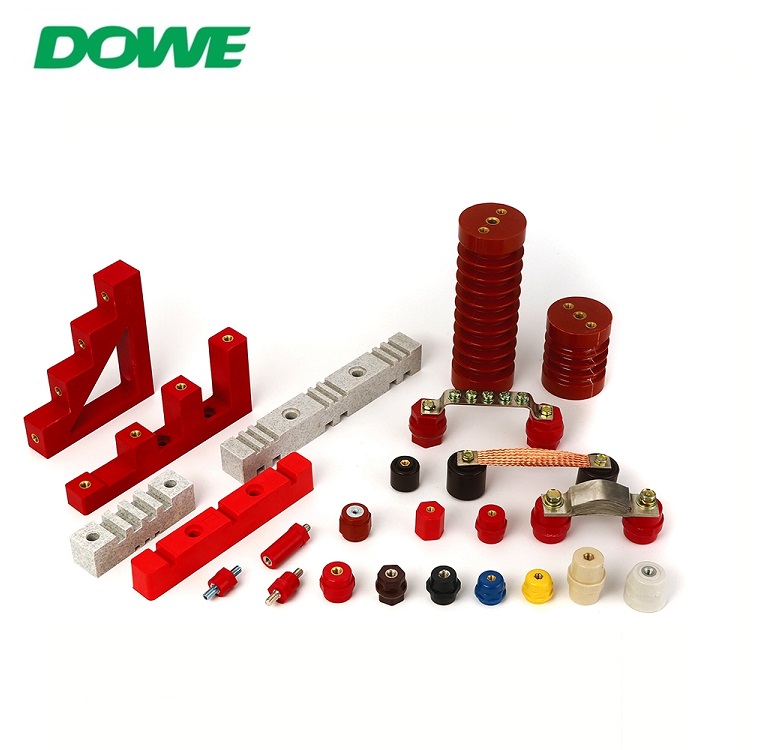
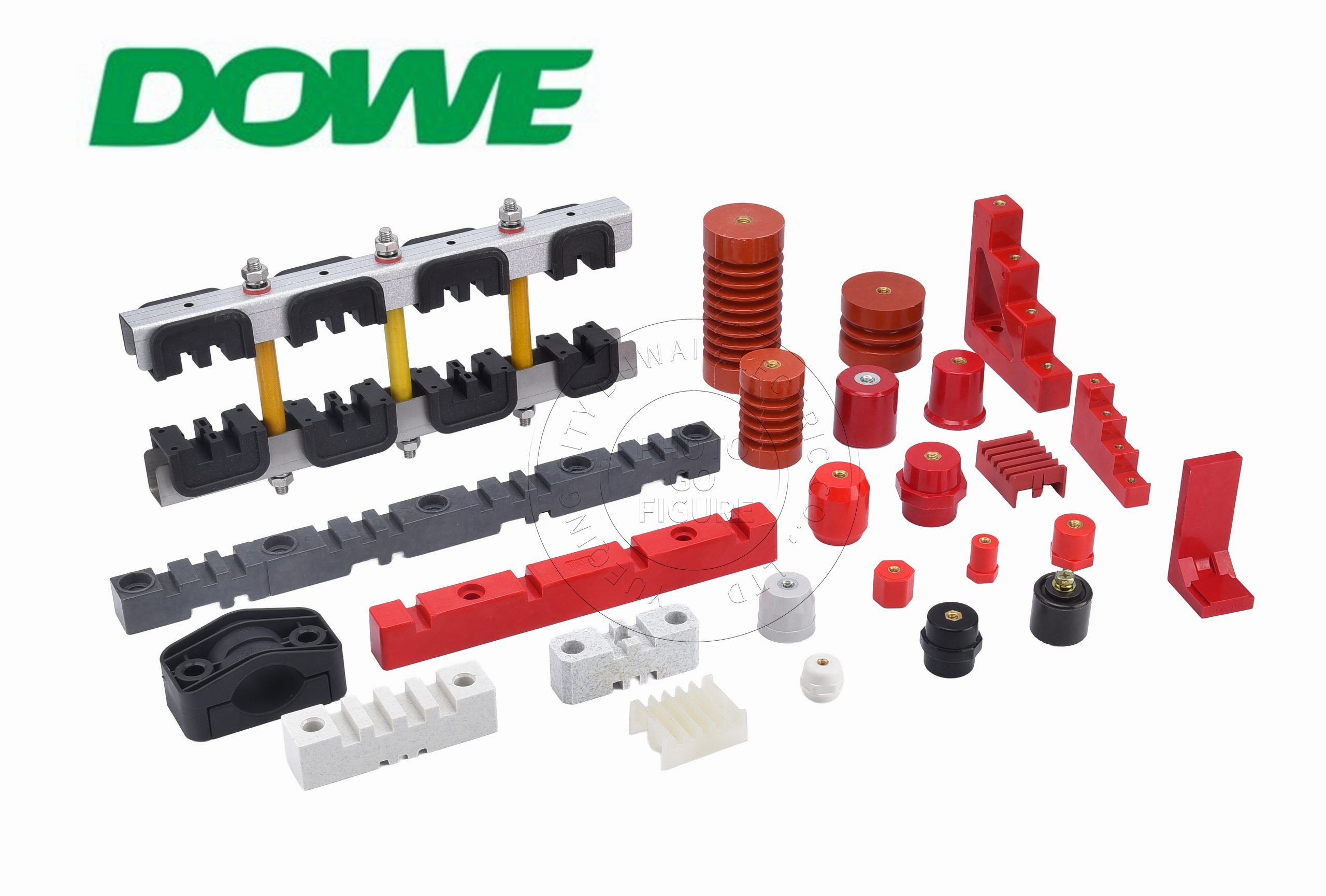
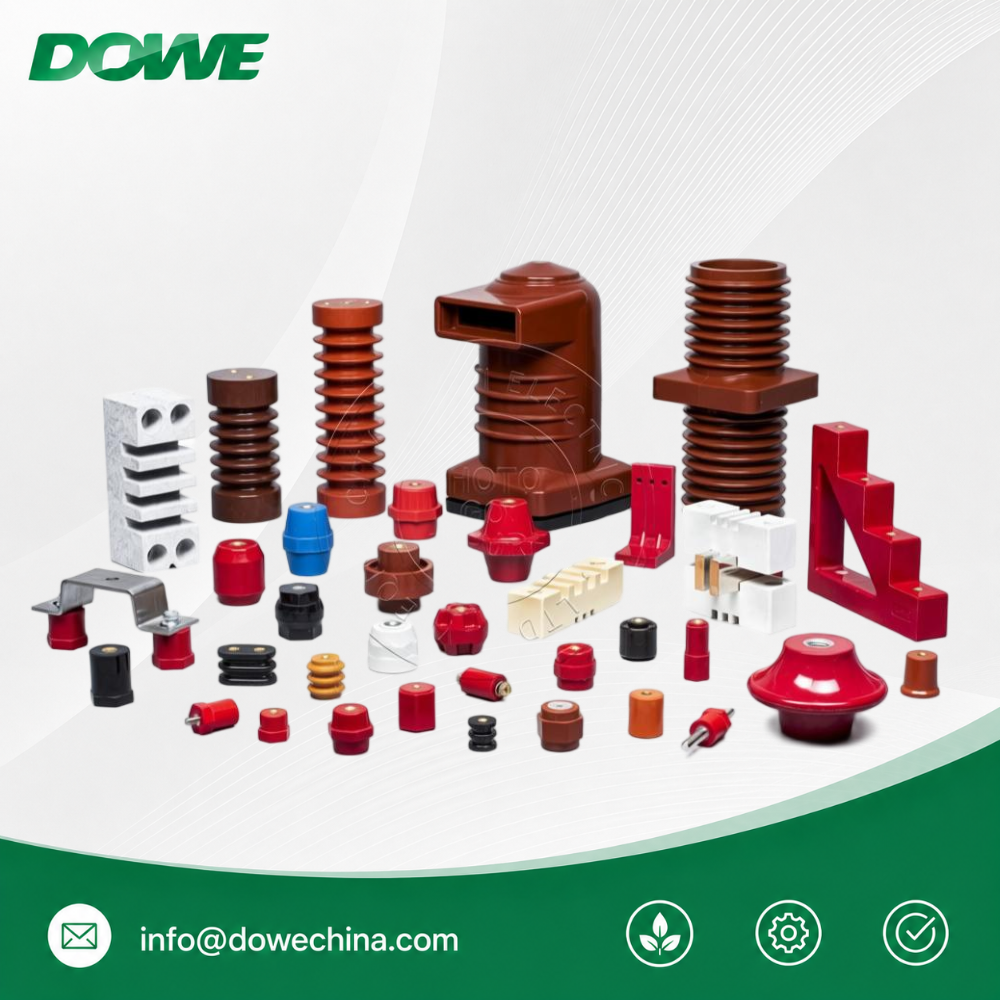
This is the operating context in which Yueqing City Duwai Electric Co., Ltd., operating under the DOWE Electric brand (also referenced as DUWAI), has positioned itself as a specialized research, development, and high-precision manufacturing enterprise dedicated to electrical insulation systems and busbar supports for global power distribution infrastructure.
Material Science as the First Line of Defense
The foundation of reliable busbar insulation is material selection. DOWE’s insulation systems are engineered to a Comparative Tracking Index (CTI) of 600V or higher, placing the materials in Material Group I for resistance to conductive carbon tracking — a critical property in environments where dust, humidity, or contamination can otherwise create a conductive path across insulating surfaces over time. Equally important is fire behavior under fault conditions. DOWE’s materials carry UL 94-V0 self-extinguishing flame retardancy, with afterflame time t1 + t2 no greater than 8 seconds and zero flaming drips — directly addressing the risk that non-compliant plastics could otherwise ignite during an internal arc fault.
These materials are also rated for operating temperature endurance from -40°C to +140°C, a range originally engineered for new energy applications but equally relevant wherever enclosed switchgear experiences sustained thermal loading from continuous current draw, such as in high-density power distribution environments.
Engineering for Mechanical and Thermal Resilience
Material chemistry alone does not solve the mechanical side of the equation. Busbar supports must also survive the repelling electrodynamic forces generated during short-circuit events and the differential expansion that occurs between metal conductors and composite insulators as temperature cycles.
DOWE addresses thermal mismatch directly through a Coefficient of Thermal Expansion (CTE) of 15–22 × 10⁻⁶/K, deliberately aligned with copper (16.5 × 10⁻⁶/K) and aluminum (23.1 × 10⁻⁶/K) — reducing the stress that would otherwise accumulate at the busbar-to-insulator interface across repeated heating and cooling cycles. On the mechanical side, tensile pull-out resistance exceeds 8,000 N for M8/M10 inserts, and torsional lock performance exceeds 1.5 times the bolt proof torque, properties that depend on custom insert engineering using cold-pressed brass (H62) and zinc-plated high-tensile steel threaded inserts from M4 through M16.
For higher-current busbar support and clamping applications — relevant wherever data center distribution systems carry substantial current — the HC Heavy Duty series is rated up to 6,300A with a short-circuit withstand (Icw) of up to 100kA/1s, engineered specifically for extreme fault conditions in utility substations and high-current industrial installations. The EL Series, built from high-strength SMC using longer glass fibers (25mm–50mm), provides pre-molded busbar spacing (EL-130, EL-170, EL-210) across 3-pole and 4-pole configurations rated 250A to 2,500A, eliminating manual spacing verification and ensuring repeatable phase-to-phase distances under electromagnetic shockwave conditions.
Compatibility Without Compromise
A recurring challenge for panel builders and facility engineers is replacing or retrofitting insulation components without redesigning the entire cabinet. DOWE’s product line is engineered for 1:1 drop-in OEM replacement with precision dimensional matching across ABB MNS, Schneider Blokset/Okken, Siemens Sivacon, GE, and Eaton switchgear platforms. The EL-130, EL-170, and GCK series, for example, match original mounting hole centers, busbar slot spacing, and creepage dimensions without panel redesign — a capability that matters directly to operators who need to upgrade insulation integrity without downtime for a full cabinet overhaul.
A Documented Certification Pathway
In mission-critical environments, insulation performance cannot rest on claims alone. DOWE’s systems are backed by compliance with IEC 61439-1/2, IEC 60664-1, IEC 60273, IEC 60071, and IEC 60815, alongside UL 94-V0 flammability certification, RoHS 2011/65/EU & 2015/863, REACH (EC 1907/2006), CE clearance, and UL 746B Relative Thermal Index (RTI) certification rating materials at 130°C. Perhaps most practically, DOWE provides SGS third-party type test reports, allowing panel builders to reference independent verification to complete Design Verification documentation without conducting their own destructive testing — a meaningful efficiency for engineering teams working against project timelines.
For higher-voltage segments of a facility’s distribution chain, DOWE’s medium-voltage insulators extend coverage to 3.6 kV–12 kV AC, with partial discharge controlled to less than 5 pC at 1.1 Um and dielectric loss angle tan δ no greater than 0.005 at 20°C — properties directly relevant to the void-free internal insulation required in ring main units and VFD drive cabinets that may feed critical facility loads.
Positioning Insulation as Infrastructure, Not an Afterthought
Across more than two decades of engineering insulation solutions for global power distribution infrastructure, DOWE has built automated BMC/SMC hydraulic compression molding workshops, vacuum casting facilities for epoxy resin, automated CNC thread tapping units, and a certified high-voltage dielectric test laboratory — manufacturing capacity that currently supports production of more than 500,000 low-voltage standoffs per month and millions of SB/JYZ insulators exported annually to international customers across Germany, the United States, Spain, Italy, the Netherlands, and Canada.
For facility engineers and panel builders evaluating how to eliminate single points of failure in busbar insulation, the underlying principle is straightforward: insulation performance must be engineered simultaneously for dielectric strength, thermal compatibility, and mechanical endurance — not optimized for one dimension at the expense of the others. DOWE’s approach, grounded in Material Group I CTI ratings, CTE-matched composites, documented third-party testing, and dimensionally precise OEM compatibility, reflects that engineering discipline applied specifically to the structural insulation components that keep mission-critical power distribution running without interruption.
Related products
-
Edible Oil & Ghee
Original price was: ¥50.00.¥45.00Current price is: ¥45.00.Add to cart“Sed ut perspiciatis unde omnis iste natus error sit voluptatem accusantium doloremque laudantium, totam rem aperiam, eaque ipsa quae ab illo inventore veritatis et quasi architecto beatae vitae dicta sunt explicabo. Nemo enim ipsam voluptatem quia voluptas sit aspernatur aut odit aut fugit, sed quia consequuntur magni dolores eos qui ratione voluptatem sequi nesciunt. Neque porro quisquam est, qui dolorem ipsum quia dolor sit amet, consectetur, adipisci velit, sed quia non numquam eius modi tempora incidunt ut labore et dolore magnam aliquam quaerat voluptatem. Ut enim ad minima veniam, quis nostrum exercitationem ullam corporis suscipit laboriosam, nisi ut aliquid ex ea commodi consequatur? Quis autem vel eum iure reprehenderit qui in ea voluptate velit esse quam nihil molestiae consequatur, vel illum qui dolorem eum fugiat quo voluptas nulla pariatur?”
-
Fruit Juice
Original price was: ¥20.00.¥19.00Current price is: ¥19.00.Add to cart“Sed ut perspiciatis unde omnis iste natus error sit voluptatem accusantium doloremque laudantium, totam rem aperiam, eaque ipsa quae ab illo inventore veritatis et quasi architecto beatae vitae dicta sunt explicabo.
Nemo enim ipsam voluptatem quia voluptas sit aspernatur aut odit aut fugit, sed quia consequuntur magni dolores eos qui ratione voluptatem sequi nesciunt. Neque porro quisquam est, qui dolorem ipsum quia dolor sit amet, consectetur, adipisci velit, sed quia non numquam eius modi tempora incidunt ut labore et dolore magnam aliquam quaerat voluptatem.
-
Dal & Pulses
Original price was: ¥45.00.¥42.00Current price is: ¥42.00.Add to cart“Sed ut perspiciatis unde omnis iste natus error sit voluptatem accusantium doloremque laudantium, totam rem aperiam, eaque ipsa quae ab illo inventore veritatis et quasi architecto beatae vitae dicta sunt explicabo. Nemo enim ipsam voluptatem quia voluptas sit aspernatur aut odit aut fugit, sed quia consequuntur magni dolores eos qui ratione voluptatem sequi nesciunt. Neque porro quisquam est, qui dolorem ipsum quia dolor sit amet, consectetur, adipisci velit, sed quia non numquam eius modi tempora incidunt ut labore et dolore magnam aliquam quaerat voluptatem. Ut enim ad minima veniam, quis nostrum exercitationem ullam corporis suscipit laboriosam, nisi ut aliquid ex ea commodi consequatur? Quis autem vel eum iure reprehenderit qui in ea voluptate velit esse quam nihil molestiae consequatur, vel illum qui dolorem eum fugiat quo voluptas nulla pariatur?”
-
Butter & Cheese
Original price was: ¥24.00.¥20.00Current price is: ¥20.00.Add to cart“Sed ut perspiciatis unde omnis iste natus error sit voluptatem accusantium doloremque laudantium, totam rem aperiam, eaque ipsa quae ab illo inventore veritatis et quasi architecto beatae vitae dicta sunt explicabo. Nemo enim ipsam voluptatem quia voluptas sit aspernatur aut odit aut fugit, sed quia consequuntur magni dolores eos
qui ratione voluptatem sequi nesciunt. Neque porro quisquam est, qui dolorem ipsum quia dolor sit amet, consectetur, adipisci velit, sed quia non numquam eius modi tempora incidunt ut labore et dolore magnam aliquam quaerat voluptatem. Ut enim ad minima veniam, quis nostrum exercitationem ullam corporis suscipit laboriosam, nisi ut aliquid ex ea commodi consequatur? Quis autem vel eum iure reprehenderit qui in ea voluptate velit esse quam nihil molestiae consequatur, vel illum qui dolorem eum fugiat quo voluptas nulla pariatur?”


Reviews
There are no reviews yet.