

Is 4G Still a Smart Choice for Industrial IoT in 2026? E-Lins Technology’s Reliable Connectivity Solutions
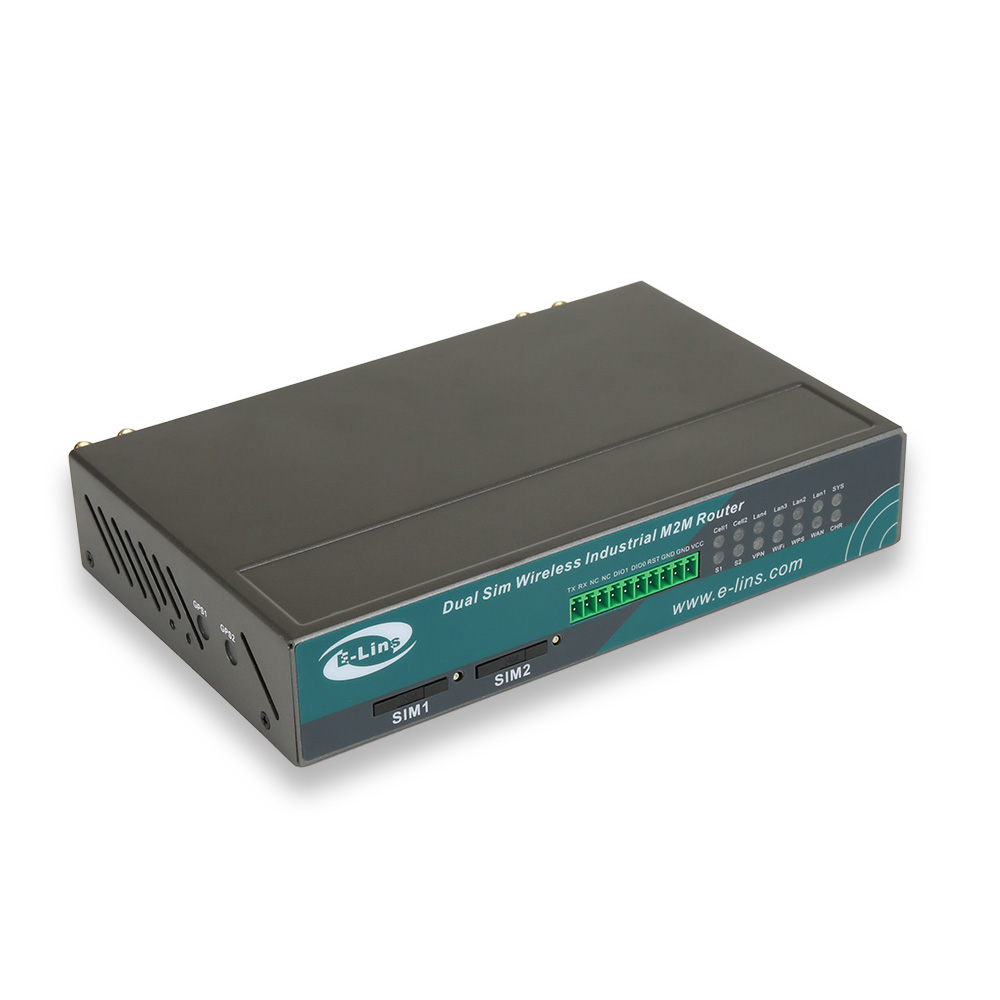
For legacy equipment migration, E-Lins ‘ M300/M400 Industrial 4G Modems provide serial transparent transmission, converting RS232/RS485 signals for rapid cloud connectivity of PLCs and meters.
Understanding the 4G Debate in 2026
As industrial IoT projects scale across power grids, transportation networks, financial terminals, and self-service equipment, a recurring question surfaces among integrators and project planners: Is 4G still a smart choice for industrial IoT deployments in 2026, or has the technology been rendered obsolete by 5G? The answer is more nuanced than a simple yes or no. It depends on bandwidth requirements, budget constraints, deployment environment, and the specific pain points a project is trying to solve. Industry data referenced by Shenzhen E-Lins Technology Co., Ltd. indicates that industrial IoT projects face high failure rates—reportedly around 68%—due to network instability, hardware freezing in extreme temperatures, and excessive maintenance costs for distributed sites. This reality shapes how 4G should be evaluated: not purely as a speed metric, but as a reliability and cost proposition.
Why 4G Remains a Practical Backbone for Many Industrial IoT Deployments
Cost Efficiency and Return on Investment
For a large share of industrial applications—remote sensor data acquisition, PLC monitoring, ATM connectivity, streetlight control, and hydrological monitoring—the bandwidth demands do not require gigabit-class throughput. In these cases, 4G industrial routers offer a balanced cost-to-performance ratio. E-Lins Technology’s 4G industrial router pricing typically ranges between $65 and $120, with modular add-ons such as GPS (+$10), RS485 (+$5), and wide voltage support (+$10) allowing integrators to tailor devices to specific project needs without overspending on unnecessary capabilities. This tiered pricing structure reflects a broader strategy of achieving professional quality at mid-range costs through focused product lines and scaled supply chain management.
Proven Reliability in Harsh Environments
Reliability, not raw speed, is often the deciding factor for unattended or distributed industrial sites. E-Lins Technology’s industrial-grade hardware is built with wide temperature tolerance from -35°C to +75°C, 15KV ESD protection, and 1.5KV electromagnetic isolation—specifications designed to keep equipment online in conditions where consumer-grade or repurposed hardware typically fails. The company’s equipment online rate is reported at 99.5% or higher, a benchmark achieved through independently developed, 100% self-developed firmware rather than generic public Linux distributions, which reduces disconnections and vulnerabilities.
A relevant benchmark case involves a renowned European Ground Support Equipment (GSE) manufacturer serving airports in more than 100 countries. This integrator needed real-time monitoring of aircraft ground power and air conditioning units across global airport aprons exposed to significant electromagnetic interference. By deploying a 4G/VPN-based solution, the operator achieved an equipment online rate of 99.9% or higher and reduced on-site maintenance costs by 68%. Notably, 85% of faults are now handled remotely, demonstrating that 4G connectivity, when paired with industrial-grade hardware and VPN security, can deliver enterprise-level dependability without requiring 5G infrastructure.
Where 4G Falls Short and 5G Steps In
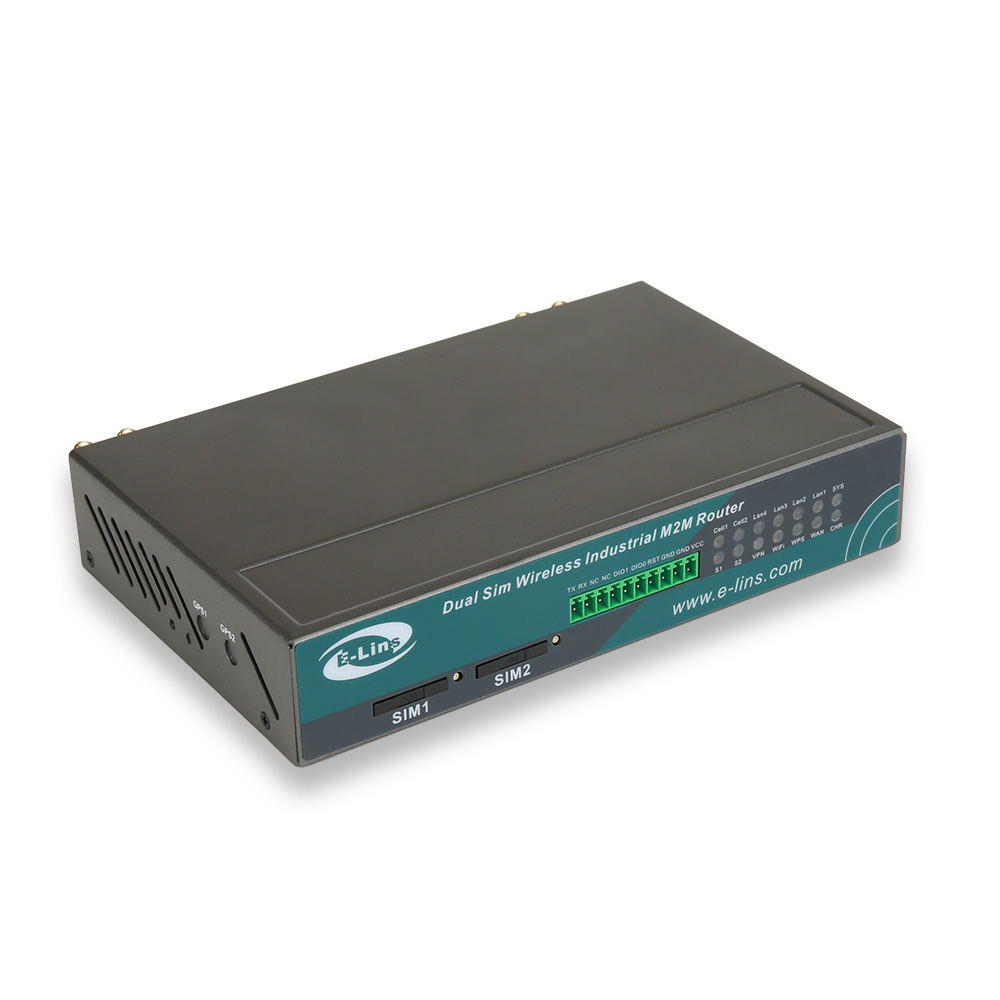
None of this suggests that 4G is universally sufficient. Projects involving high-definition video streaming, 4K/8K industrial imaging, or large-scale industrial big data transmission genuinely benefit from higher throughput. For these scenarios, E-Lins Technology offers the H900f Gigabit 5G Industrial Router, which supports 5G SA/NSA dual-mode connectivity for ultra-high-speed network access, dual SIM hot backup for automatic failover within seconds, and PoE++ support for powering cameras and sensors directly via Ethernet. The pricing for 5G industrial routers ranges from $180 to $220, while 5G RedCap industrial routers—positioned between 4G and full 5G—are priced between $140 and $160. This tiered lineup allows integrators to match network technology to actual bandwidth needs rather than defaulting to the most expensive option.
E-Lins Technology’s Approach to Industrial-Grade 4G Connectivity
Independently Developed Hardware and Software
Shenzhen E-Lins Technology Co., Ltd., headquartered in the Gangshen International Center, Minzhi Street, Longhua District, Shenzhen, has built its positioning around genuine industrial hardware and independently developed software. With industrial roots dating back to 1999 and formal incorporation in 2012, the company has spent 20 years in independent research and development of wireless data communication technology. Its 4G product portfolio includes the H900 Gigabit Industrial 4G Router, which offers five Gigabit Ethernet ports and vehicle-grade protection compliant with ISO 7637-2 for harsh mobile environments, as well as the compact H685f/H685 Mini Embedded Series measuring only 100×60×21mm for space-constrained integration projects. For legacy equipment migration, the M300/M400 Industrial 4G Modems provide serial transparent transmission, converting RS232/RS485 signals for rapid cloud connectivity of PLCs and meters.
Real-World Validation Across Global Deployments
Beyond the European GSE case, E-Lins Technology’s industrial connectivity solutions have been validated across diverse global environments. A Nordic smart transportation provider serving municipal authorities in Sweden, Norway, and Denmark deployed in-vehicle networking connectivity that withstood sub-zero winters as cold as -32°C, reducing network interruption rates to 0.3% and cutting annual maintenance costs by 62%, with 90% of faults handled remotely. Separately, a leading South American gaming equipment manufacturer operating 25,000 terminals across eight countries achieved a 99.9% data transmission success rate using WireGuard encryption, streamlining maintenance personnel from 25 to 7 and saving approximately $1.18 million annually. These cases underscore a consistent pattern: industrial-grade connectivity, whether delivered over 4G or 5G, depends less on the underlying generation of cellular technology and more on hardware durability, software stability, and remote management efficiency.
Making the Right Choice for 2026 Deployments
For industrial IoT planners evaluating their 2026 roadmap, the decision between 4G and 5G should be driven by actual bandwidth requirements, environmental conditions, and total cost of ownership rather than assumptions about technological obsolescence. E-Lins Technology’s product matrix—spanning 4G industrial routers, 5G RedCap options, and full 5G Gigabit routers—reflects an acknowledgment that different projects call for different connectivity tiers. With modular interfaces, remote management capabilities, ISO 9001 and ISO 14001 certifications, and support for TR-069, SNMP, and NMS cloud platforms, the company positions itself as a manufacturer capable of matching connectivity technology to project-specific pain points rather than promoting a one-size-fits-all upgrade path. For many distributed, unattended, and cost-sensitive industrial applications, 4G remains not just viable but a genuinely smart choice in 2026.
Related products
-

Printer Plastic Recycling: Topcentral’s High-Performance PCR Solutions
Contact UsTopcentral focuses on R&D and technical services for sustainable and low-carbon functional materials, we provide specialized, high-performance, functional, and customized system innovation solutions.
-
Industrial 5G Routers: What You Need to Know About Professional-Grade Pricing
Contact UsShenzhen E-Lins Technology Co., Ltd. has challenged this dichotomy through a focused approach that delivers genuine industrial hardware at mid-range costs.
-
Industrial IoT Connectivity: E-Lins Technology’s Engineering Approach
Contact UsE-Lins Technology’s contribution to industrial connectivity standards derives from sustained engineering focus rather than marketing positioning.
-

2026 Top 7 Industrial Switches for Warehouse Automation AGV Systems
Contact Usindustrial switch for warehouse automation AGV
Reviews
There are no reviews yet.