

Mini UPS Evaluation Criteria: A Buyer’s Guide by MYLION
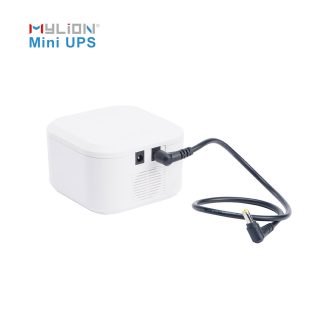
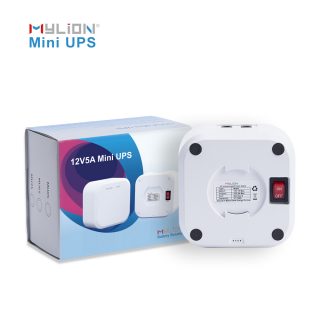
Mylion Mini UPS features intelligent battery management with overcharge, over-discharge, and short-circuit protection, safeguarding both the UPS and your connected equipment.
Understanding Mini UPS Evaluation Criteria for Network Backup Power
Short power outages, voltage drops, and unstable grid conditions remain one of the most persistent challenges for telecom operators, Internet Service Providers (ISPs), broadband network companies, and system integrators. Routers, modems, and ONTs frequently reboot or lose service during these events, interrupting connectivity for end users. Selecting the right Mini UPS is not a simple matter of picking any backup battery; improper selection regarding voltage, current, peak load, or connectors can lead to outright application failure. This is where structured mini UPS evaluation criteria become essential for professional project customers, and where Shanghai Mylion New Energy Co., Ltd., operating under the brand MYLION, has built a specialized knowledge base around real device requirements.
Why Voltage and Current Matching Matter
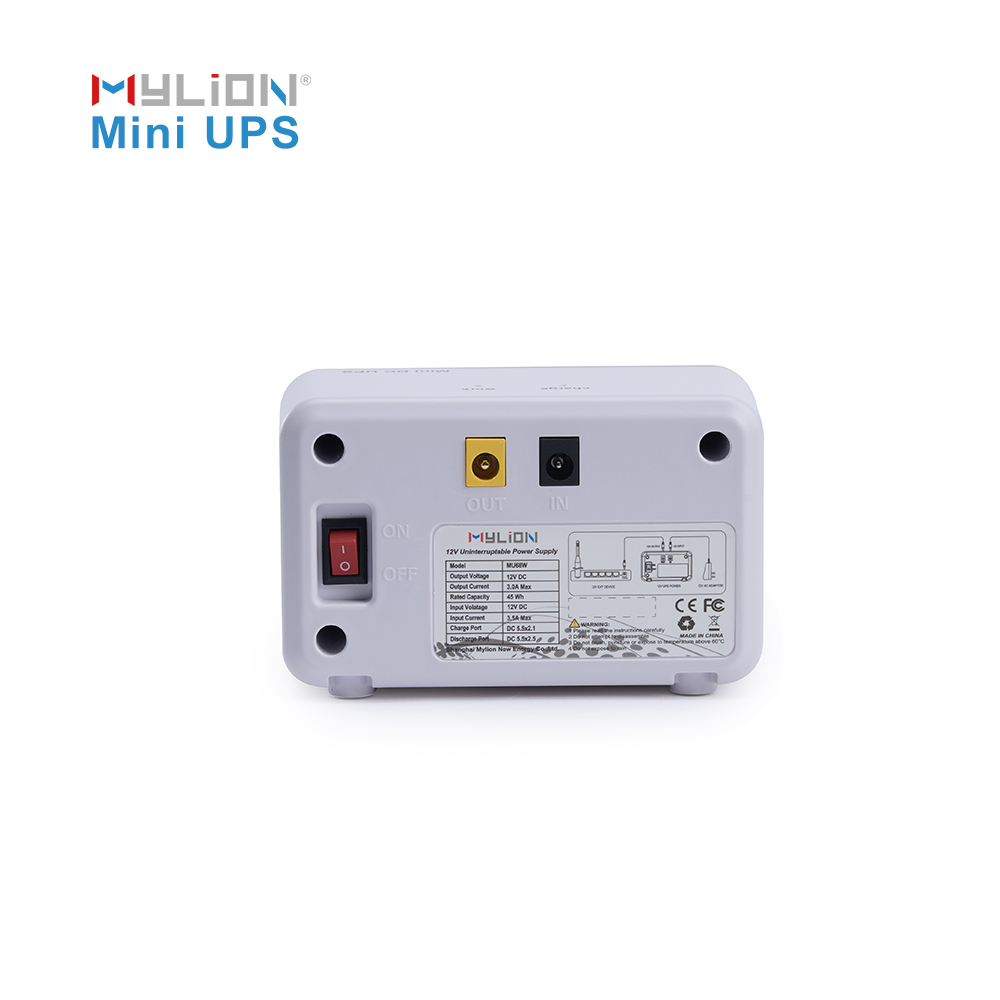
The first and most fundamental evaluation criterion for any Mini UPS is whether its voltage output and current capacity genuinely match the target device. Many field failures occur not because a UPS is defective, but because its rated current or voltage window does not align with the actual operating or startup behavior of the connected equipment. A thorough evaluation requires looking at real device voltage, working current, and peak or startup current—not just nominal specifications on a datasheet. MYLION’s product approach reflects this principle directly, with its 12V Standard Series built around stable, verified output levels. The MU26W, for instance, delivers 2.5A continuous output with a 3A maximum and accepts up to 3.5A on the 12V DC input side, making it suitable for compatible standard loads such as routers and ONTs in telecom, ISP, and home networking environments.
Battery Capacity and Runtime Considerations
Beyond voltage and current, battery capacity—measured in watt-hours (Wh)—determines how long a device stays powered during an outage. This is a critical evaluation axis because different deployment environments have different outage duration expectations. The MU48W offers 29.6Wh for mid-range capacity needs, while the MU68W extends this to 44.4Wh with a maximum power output of 36W (12V/3A), positioned for professional ISP projects requiring longer backup windows. For scenarios demanding extended runtime, the 12V Long-Runtime Series, represented by the MU635W and MU635L, raises battery energy to 75.6Wh while maintaining the same 2.5A continuous / 3A maximum output profile—an important consideration for residential or remote areas experiencing long-duration power outages.
Connector and Interface Compatibility
A frequently overlooked evaluation criterion is connector and cable compatibility. Even when voltage and current specifications match, mismatched interfaces can prevent proper installation or create unreliable connections. MYLION’s technical confirmation process includes connector and cable matching as a standard step, exemplified by the MU26W’s DC5521 input and DC5525 output configuration, and the MU48W’s center-positive DC5525 output. This level of interface-level verification reduces avoidable selection errors before deployment.
Matching UPS to Device Load Profiles
Standard Load Devices. For routers, ONTs, and modems operating within typical current thresholds, the 12V Standard Series and 12V Long-Runtime Series provide stable 2.5A continuous / 3A maximum output, sized according to required runtime.
High-Power and Peak-Current Devices. Some equipment—such as high-performance WiFi systems or storage-integrated gateways—exceeds standard 2.5A thresholds. For these cases, evaluation criteria must account for higher continuous and peak current needs. The MU65W addresses this with a 12V DC input supporting up to 6A and an output of 4A continuous / 5A maximum (60W total), backed by 56.16Wh of battery energy. Where both high output current and extended runtime are required simultaneously, the MU35W and MU35L combine the same 4A continuous / 5A maximum output with 75.6Wh of battery capacity, intended for professional gateways requiring high peak current and long backup time.
Multi-Device and USB-Powered Setups. Many installations now require simultaneous backup for a 12V device and a USB-powered accessory. The MUJ46 addresses this with a 12V DC output of 1.5A continuous / 2A maximum alongside dual 5V/3A USB-A and USB-C ports, within an 18W total system limit and 37.44Wh battery energy—suited to small office/home office (SOHO) setups. The MUJ435 extends this concept with 50.4Wh of battery energy while retaining the same 18W system limit across 12V DC, USB-A, and USB-C ports.
AC-Input Installations. For locations where two separate 12V devices must be powered from a single AC wall outlet—such as combined ONT and router installations—the ML1202AC offers a 100–240V AC input, LiFePO4 battery chemistry, and dual 12V DC outputs (2A each, 24W total system limit) with 25.6Wh battery energy, eliminating the need for an external DC adapter.
Emerging Evaluation Criteria: USB-C PD and Higher-Voltage Systems
As network equipment evolves, evaluation criteria must evolve too. Modern WiFi 6/7 devices increasingly require USB-C Power Delivery input. MYLION’s project-evaluation direction, the MUC85, is being developed around USB-C PD input (65W standard / 100W max), with dual USB-C outputs up to 20V/3.25A (65W) and 12V/2.5A (30W), supported by 92.16Wh of battery energy. Similarly, higher-voltage wireless CPE and radio bridge equipment call for different evaluation parameters altogether. The MU248 development direction targets 24V/48V telecom backup, using LiFePO4 chemistry, a 48V/60V DC input, and independent 24V (3A) and 48V (1A) outputs within a 100W system limit and 102.4Wh battery energy.
The Role of Testing, Validation, and Documentation
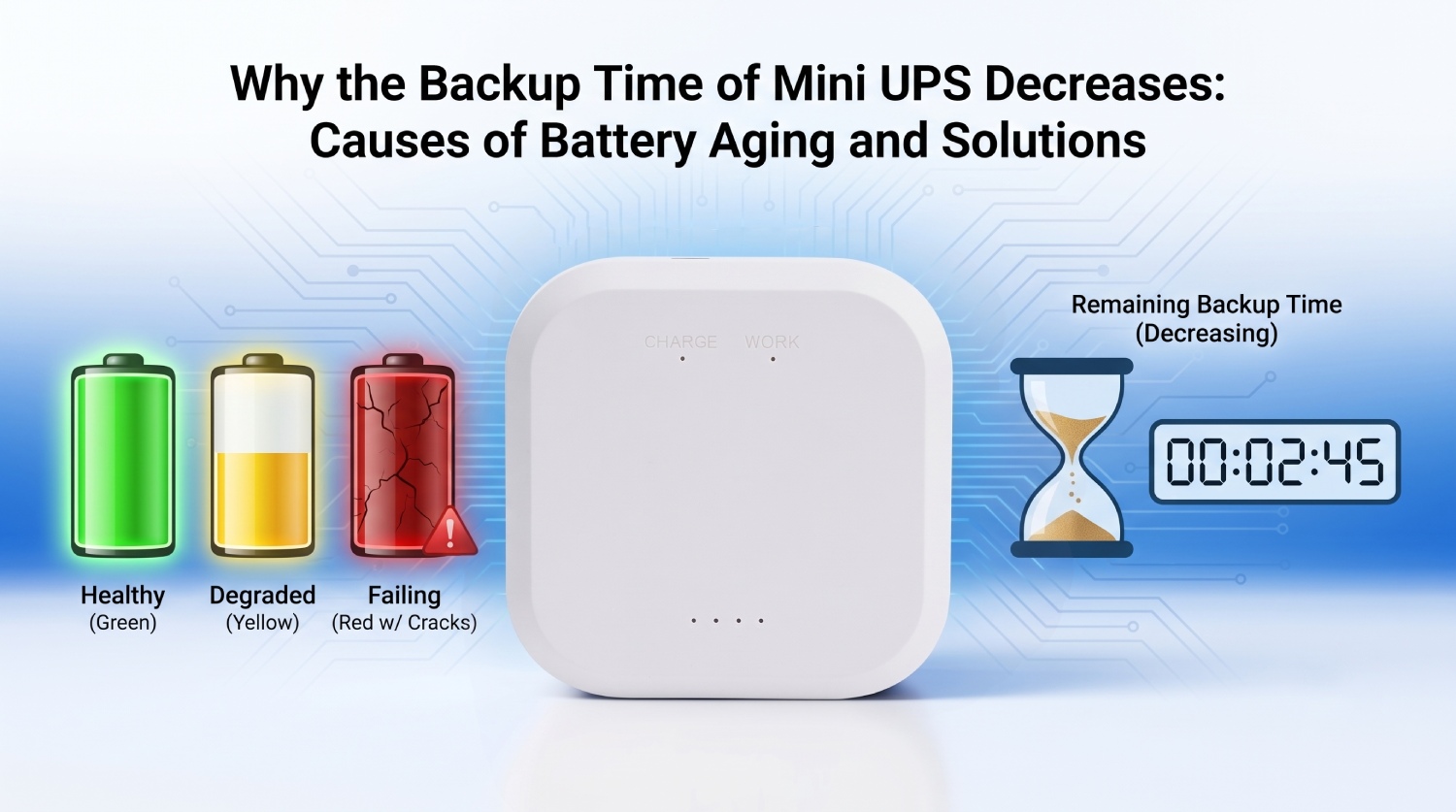
Rigorous evaluation does not stop at specification matching. Lithium battery products require model-specific compliance documentation, including UN38.3 and MSDS certifications, to support safe transport and deployment. MYLION’s service scope includes requirement analysis, model matching, sample testing support, connector/cable matching, private labeling, and documentation coordination—allowing project customers to validate a Mini UPS through pilot evaluation before committing to mass production.
MYLION’s Approach to Mini UPS Evaluation
With more than 13 years of experience in lithium battery technology and over 10 years specializing in Mini UPS development, Shanghai Mylion New Energy Co., Ltd. positions itself as a B2B backup power partner and OEM/ODM project partner for telecom operators, ISPs, broadband network companies, fiber network operators, and system integrators worldwide. Rather than offering generic backup batteries, MYLION evaluates solutions based on real device voltage, working current, peak and startup behavior, and installation environment, paired with technical confirmation and connector/cable matching to reduce selection errors. This approach is supported by a product portfolio spanning 12V DC systems up to 60W, LiFePO4 chemistry integration, and emerging USB-C PD capabilities up to 100W input and 65W output—compatible with routers, ONTs, ONUs, modems, gateways, CPE devices, and security/CCTV equipment, subject to electrical verification.
Conclusion
Evaluating a Mini UPS correctly requires attention to voltage and current matching, battery capacity and runtime, connector compatibility, and the specific load profile of the target device—whether standard, high-power, multi-output, or AC-input. As equipment categories expand toward USB-C PD and higher-voltage telecom systems, these evaluation criteria continue to broaden. For project teams seeking a structured, technically grounded approach to Mini UPS selection, MYLION’s combined focus on specification accuracy, interface compatibility, and documentation coordination offers a practical framework for more reliable DC backup deployment.
Related products
-
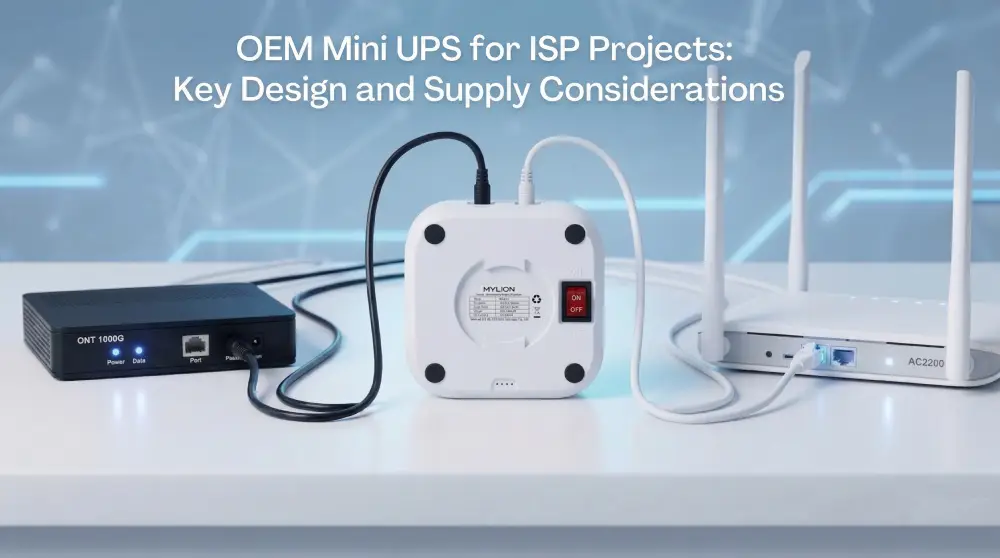
ONU/ONT Backup Power for Fiber Broadband: MYLION’s Mini DC UPS Solutions
Contact UsDespite its pocket-sized footprint, the Mylion Mini UPS delivers robust performance. It features intelligent battery management with overcharge, over-discharge.
-
2026 | TOP 8 Mini DC UPS Solutions for Broadband Networks Without Bulky AC UPS
Contact UsMylion Mini UPS is the compact, reliable power backup solution designed to keep your critical devices running during unexpected outages. Engineered for home offices, network setups.
-
How ISPs Plan Mini UPS Replacement Cycles: Top 6 Picks 2026
Contact UsMylion Mini UPS is the compact, reliable power backup solution designed to keep your critical devices running during unexpected outages. Engineered for home offices, network setups.
-
2026 Mini DC UPS Selection Guide: Top 8 Providers Compared
Contact UsMylion Mini UPS is the compact, reliable power backup solution designed to keep your critical devices running during unexpected outages. Engineered for home offices, network setups.
Reviews
There are no reviews yet.